
How to sell on Meesho in India in 2026 is one of the most searched questions among new online sellers — and for good reason. With over 1.1 million active sellers, 14 crore+ customers, and coverage across 28,000+ pin codes, Meesho has become India’s most accessible gateway to e-commerce.
You don’t need a website. You don’t need a warehouse network. You don’t even need deep technical knowledge to start. And unlike Amazon or Flipkart, Meesho charges 0% commission on most product categories — meaning you keep the full selling price, minus shipping charges.
But here’s what most beginner guides don’t tell you: the moment you start selling at scale on Meesho, your biggest operational challenge isn’t finding products or getting orders. It’s managing shipping costs, controlling your RTO rate, and building a logistics setup that doesn’t eat your margins alive.
This guide covers everything — from Meesho seller registration to shipping charges, COD management, RTO reduction, and what to do when you’re ready to grow beyond Meesho’s built-in logistics.
Why Sell on Meesho in 2026?
Before diving into the how, it helps to understand why Meesho is worth your time in 2026.
Meesho has emerged as one of India’s fastest-growing e-commerce platforms, particularly for sellers targeting price-conscious consumers in Tier 2, Tier 3, and rural markets. With over 130 million monthly active users and a zero-commission model that sets it apart from Amazon and Flipkart, Meesho offers a unique opportunity for sellers looking to expand their reach.
Key advantages for new sellers:
- 0% commission on most categories — you keep 100% of your selling price
- Zero upfront cost — no listing fees, no monthly subscription
- Meesho handles logistics — pickup, delivery, and returns are managed through their logistics network
- No minimum order requirement — start with as few orders as you like
- GST-optional for small sellers — if your annual turnover is below ₹40 lakhs (₹20 lakhs in some states), you can sell on Meesho without GST registration
- Pan-India reach — 28,000+ serviceable pin codes from day one
The platform is particularly powerful for sellers in fashion, home décor, kitchen products, beauty, and lifestyle — categories where volume matters more than premium pricing.
Step-by-Step: How to Register as a Meesho Seller
Registering on Meesho is straightforward. Visit supplier.meesho.com and click on “Start Selling.” You will need your GSTIN (GST Identification Number), PAN card, a bank account with the registered business name, and a valid mobile number. The registration process takes about 15–20 minutes, and account verification typically completes within 24–48 hours. Once verified, you can start listing products immediately.
Here’s the complete document checklist:
| Document | Required? | Notes |
|---|---|---|
| PAN Card | ✅ Mandatory | Personal or business PAN |
| Bank Account | ✅ Mandatory | Must match business name |
| Mobile Number | ✅ Mandatory | For OTP verification |
| GSTIN | For most sellers | Optional below ₹40 lakh turnover |
| Product photos | ✅ Mandatory | Minimum 2 images per product |
| Pickup address | ✅ Mandatory | Where courier will collect parcels |
Step 1: Go to supplier.meesho.com and click “Start Selling”
Step 2: Enter your mobile number and verify via OTP
Step 3: Fill in your business details — name, address, PAN, and bank account
Step 4: Add your GSTIN (if applicable) or indicate you’re a non-GST seller
Step 5: Wait 24–48 hours for account verification
Step 6: Once approved, start uploading your product catalogue
How to List Products on Meesho
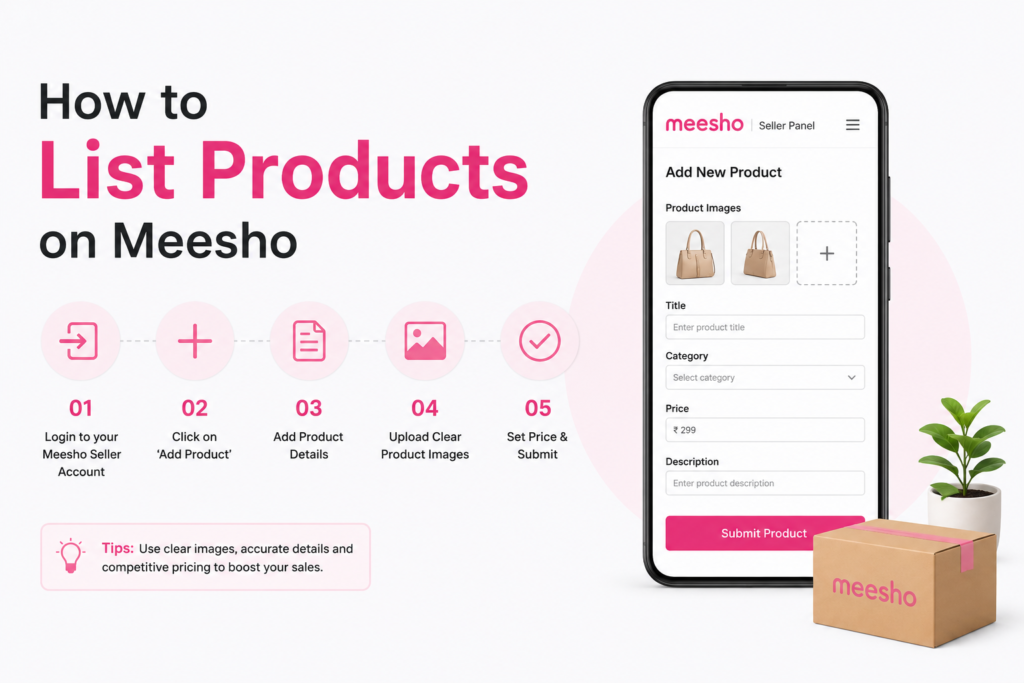
Once your seller account is active, product listing is your next step. Meesho’s algorithm rewards active sellers who list consistently — adding new products every 10–15 days signals to the platform that you’re an engaged supplier and boosts your catalogue’s visibility in search results.
What makes a strong Meesho listing:
Product title: Clear, descriptive, keyword-rich. Include the product type, key feature, size or colour variant, and occasion if relevant. Example: “Women’s Cotton Anarkali Kurta — Floral Print, Sizes S–3XL, Casual Wear”
Images: Meesho shoppers are largely visual buyers browsing on mobile. Use high-quality images on a white or neutral background. Include at least one image with a model (for apparel) or in-context usage shot (for home products). Blurry or poorly lit images directly reduce your conversion rate.
Price: Meesho follows a supply price model, not direct selling price. Correct pricing is critical to avoid losses and RTO issues. Price too low and your margin disappears after shipping. Price too high and you lose to competitors. Research similar products on the platform and price within 5–10% of the competitive range.
Product details: Fill every field — size, material, colour, weight. Missing product information increases return rates because customers receive items that don’t match expectations.
Weight entry — this is critical: The weight you enter for your product directly affects your shipping charge. Entering incorrect weight (lower than actual) will cause weight discrepancy issues during pickup, leading to higher charges or delayed settlements. Always weigh your packed product (product + packaging material) and enter that figure, not just the product weight.
Meesho Shipping Charges Explained (2026)
This is where most new Meesho sellers get their first unpleasant surprise. Meesho charges 0% commission — but shipping charges are deducted from every order settlement, and they add up fast.
Meesho shipping charges are calculated automatically based on packed weight, delivery zone, and reverse logistics. While the platform follows a low-commission model, forward and RTO shipping costs directly impact your final settlement. Even small weight differences can move your product into a higher slab and reduce margins.
Meesho Shipping Rate Slabs (2026)
Meesho uses Valmo — its own logistics vertical — to aggregate multiple courier partners and offer competitive shipping rates.
| Packed Weight | Local Zone | Regional Zone | National Zone |
|---|---|---|---|
| Up to 500g | ₹35 – ₹45 | ₹45 – ₹55 | ₹55 – ₹65 |
| 500g – 1 kg | ₹45 – ₹60 | ₹55 – ₹70 | ₹65 – ₹85 |
| 1 kg – 2 kg | ₹60 – ₹80 | ₹75 – ₹95 | ₹90 – ₹115 |
| 2 kg – 5 kg | ₹90 – ₹120 | ₹110 – ₹145 | ₹130 – ₹175 |
Rates are indicative. An additional 18% GST applies to the shipping fee. Actual charges depend on courier partner allocation and pin code. Always check the shipping estimate in your Meesho Supplier Panel for each specific order.
The “0% Commission” Reality Check
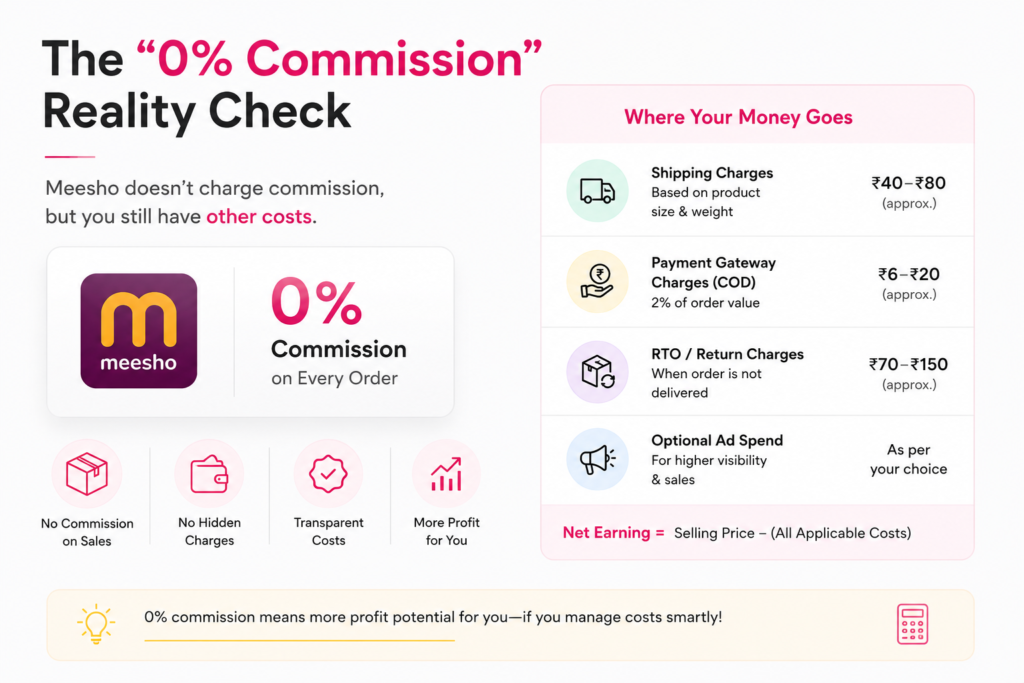
Many new sellers misunderstand Meesho’s cost structure. Here’s what a real order looks like:
Example: Selling a kurti at ₹499
| Item | Amount |
|---|---|
| Selling price | ₹499 |
| Meesho commission (most categories) | ₹0 |
| Forward shipping (500g, national) | – ₹65 |
| GST on shipping (18%) | – ₹11.70 |
| Net settlement (if delivered) | ₹422.30 |
| Your product cost | – ₹250 |
| Packaging material | – ₹15 |
| Gross profit (if delivered) | ₹157.30 |
Now factor in RTO. If 20% of your orders come back:
| Scenario | Cost |
|---|---|
| Forward shipping (lost on RTO) | – ₹65 |
| Return shipping charge | – ₹40 (approx.) |
| Total loss per RTO order | ₹105 + your product is back in stock but you’ve lost ₹105 |
On 100 orders with 20% RTO, you lose ₹2,100 purely in shipping on failed orders. This is why managing RTO is not optional — it is the difference between profit and loss.
Understanding COD on Meesho
Cash on Delivery is the dominant payment mode on Meesho. The platform’s customer base is heavily Tier 2 and Tier 3 — price-sensitive shoppers who strongly prefer COD over prepaid UPI or card payments.
How COD works for Meesho sellers:
- Customer places a COD order — no payment at order stage
- Meesho’s logistics partner picks up the product from you
- Delivery partner collects cash from the customer at delivery
- Payments from Meesho are credited directly to your linked bank account every 7 days after delivery, even for Cash on Delivery (COD) orders
COD charges on Meesho: COD orders attract a slightly higher shipping charge than prepaid orders on most platforms. On Meesho, COD handling is built into the shipping fee — there is no separate COD surcharge listed, but the effective per-order shipping cost for COD orders is typically ₹5–₹15 higher than equivalent prepaid orders.
The COD cash flow challenge:
The 7-day payment cycle means your cash is locked for a week after each delivery. For sellers shipping 50–100 orders per week, this creates a working capital gap — you’re buying and packaging new inventory before last week’s settlements have arrived. Plan for this by maintaining a buffer of at least 2 weeks’ inventory cost in working capital.
COD verification tip: Before dispatching high-value COD orders (above ₹600–₹800) from new customers with no purchase history, consider sending a quick WhatsApp confirmation. While Meesho doesn’t provide customer phone numbers directly, building habits around order verification reduces impulse cancellations and RTO.
Meesho RTO — What It Is and How to Reduce It
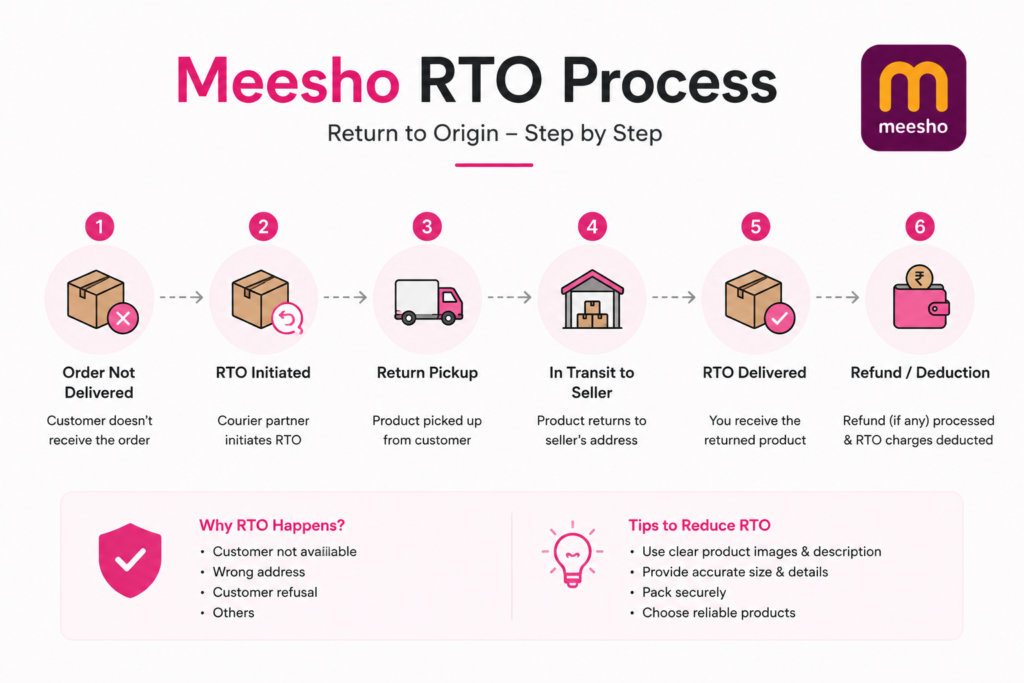
RTO (Return to Origin) is the single biggest profitability threat for Meesho sellers. RTO is when a package fails to deliver and returns to the seller. Meesho does not charge a separate RTO fee — however, you lose the forward shipping cost on every RTO order.
In some categories on Meesho — particularly fashion, where customers often order multiple sizes — RTO rates can exceed 25–35%. Every RTO order costs you forward shipping (₹40–₹85 depending on zone and weight) plus return shipping (₹35–₹60), plus the time your inventory was out of your hands.
Why RTO Happens on Meesho
Wrong address or unreachable customer: The most common cause. Customers in Tier 2/3 towns sometimes enter incomplete addresses or are unavailable during delivery attempts.
Impulse orders: Meesho’s low prices and easy COD encourage impulse purchases. Some customers order without strong intent to receive — especially during sale events.
Expectation mismatch: Product arrives looking different from the listing photos. This is a listing quality problem, not a shipping problem.
Delivery attempt failure: Courier partner makes one or two delivery attempts, customer is unavailable, parcel is marked RTO.
7 Proven Ways to Reduce Your Meesho RTO Rate
1. Enter accurate product weight. Weight discrepancies cause disputes and delayed pickups, which can result in RTOs before delivery even starts.
2. Use precise product descriptions and real product images. The closer your listing is to what arrives in the customer’s hands, the fewer expectation-gap returns you’ll see.
3. Include accurate size charts for apparel. Fit issues are the #1 cause of returns in fashion. A clear, measurement-based size chart prevents the majority of sizing returns.
4. Enrol in Meesho’s Next Day Dispatch (NDD) programme. Next Day Dispatch (NDD) is Meesho’s programme that lets sellers ship orders to customers the next day after they are placed. Once you enlist in this programme, your catalogue appears at the top of the homepage. The NDD facility reduces order cancellations and RTO, ultimately leading to growth.
5. Pack securely. A damaged product arriving in poor condition triggers both a return and a negative review. Use appropriate packaging for your product type — poly mailers for apparel, corrugated boxes for fragile items.
6. Maintain a high seller rating. Meesho’s algorithm prioritises listings from high-rated sellers. Better placement means more genuine buyers, which correlates with lower RTO rates.
7. Monitor your RTO tab regularly. If the customer doesn’t receive the product, it will be returned to you, which you can find in the “RTO” tab. Track your RTO rate by product category and identify which SKUs are generating the most returns — sometimes a single problematic listing is responsible for a disproportionate share of your RTO.
Meesho Payment Cycle — When Does Money Arrive?
Understanding the payment cycle is essential for cash flow management.
Payments on Meesho are credited directly to your linked bank account every 7 days after delivery, even for COD orders. Delivered orders are visible under the Payment tab, pending or disputed payments under Verification, and returns and RTO under the Returns or RTO tab. Every transaction on Meesho is transparent — you can see the payment date, amount, and bank reference number.
Payment cycle summary:
| Event | When payment arrives |
|---|---|
| Prepaid order delivered | 7 days after delivery |
| COD order delivered | 7 days after delivery |
| RTO order | No payment (shipping cost deducted) |
| Customer-initiated return | After return pickup confirmed |
Managing payment cycles as you scale:
At low volumes (10–20 orders per week), the 7-day cycle is manageable. At higher volumes (100+ orders per week), you have multiple weeks of settlements in the pipeline simultaneously. Keep a running spreadsheet of expected settlement dates versus actual credits. Delays in settlement — though uncommon on Meesho — are easier to catch and escalate when you have records.
Meesho Shipping Charges vs Independent Courier — What’s the Real Difference?
Meesho’s built-in logistics (Valmo) is convenient and cost-effective for most sellers starting out. But as you grow and start shipping beyond Meesho — on your own website, Instagram store, WhatsApp, or other marketplaces — you’ll need your own courier setup.
Here’s a side-by-side comparison:
| Factor | Meesho Built-in Logistics | Independent Courier Aggregator |
|---|---|---|
| Shipping cost | ₹35–₹85 per order (auto-deducted) | ₹30–₹90 per order (negotiable at volume) |
| Courier choice | Meesho assigns partner | You choose from 15+ options |
| COD remittance | 7 days | 2–5 days (depending on courier) |
| Non-Meesho orders | ❌ Not supported | ✅ All channels |
| Tracking | Meesho Supplier Panel only | Unified dashboard across all orders |
| Rate negotiation | ❌ Fixed slabs | ✅ Volume-based discounts |
| RTO management | Basic | Advanced NDR automation |
The transition point: Most Meesho sellers find that once they’re consistently shipping 50+ orders per week, the limitations of Meesho’s built-in logistics become apparent — especially if they’re selling across multiple channels simultaneously.
Growing Beyond Meesho — When to Add Your Own Shipping
Meesho is an excellent starting point. But the most successful Indian online sellers don’t stay exclusively on one platform. They start on Meesho, validate their products, build operational discipline, and then expand to their own website, Instagram store, or other marketplaces — each requiring their own shipping setup.
Signs you’ve outgrown Meesho’s built-in logistics:
- You’re receiving orders through Instagram DMs or WhatsApp in addition to Meesho
- Your Meesho RTO rate is high and you want more control over delivery partner selection
- You want faster COD remittance than Meesho’s 7-day cycle
- You’re listing on multiple platforms (Amazon, Flipkart, Meesho simultaneously)
- You want to build your own brand website and ship directly to customers
At this stage, a courier aggregator gives you the multi-courier flexibility that Meesho’s built-in logistics doesn’t — letting you compare rates, choose the best carrier for each shipment, and manage all your orders across all channels in one place.
How ShipEasy Helps Meesho Sellers Scale

ShipEasy is a courier aggregator designed for Indian e-commerce sellers at every stage — including Meesho sellers who are ready to take their shipping operations to the next level.
Whether you’re expanding beyond Meesho to your own website, managing orders from Instagram and WhatsApp alongside your Meesho store, or simply want more control over your courier selection and RTO management, ShipEasy gives you:
- Live rate comparison across 15+ courier partners — Delhivery, DTDC, Blue Dart, XpressBees, Amazon Shipping, India Post, and more
- Faster COD remittance — T+2 to T+4 settlement versus Meesho’s 7-day cycle on most courier partners
- NDR automation — act on every failed delivery attempt within 24 hours, before it becomes an RTO
- Unified tracking dashboard — all shipments across all channels in one place
- Bulk label generation — upload all your orders via CSV and generate labels in minutes
- No minimum volume — start with your first non-Meesho order and scale from there
The goal isn’t to replace Meesho — it’s to give you the shipping infrastructure to build a business that doesn’t depend on any single platform.
👉 Start comparing courier rates free on ShipEasy → shipeasy.tech
Meesho Seller Profit Calculator — How to Price Your Products
Before listing any product on Meesho, run this simple profitability check:
Meesho Profit Formula:
Net Profit = Selling Price − Product Cost − Packaging Cost − Forward Shipping − (RTO % × (Forward Shipping + Return Shipping))
Example for a 400g fashion accessory selling at ₹349:
| Item | Amount |
|---|---|
| Selling price | ₹349 |
| Product cost | ₹150 |
| Packaging (poly mailer + tape) | ₹10 |
| Forward shipping (500g, national) | ₹65 |
| GST on shipping (18%) | ₹11.70 |
| RTO cost (20% rate × ₹105 avg) | ₹21 |
| Estimated net profit | ₹91.30 |
Gross margin: ~26%
At 26% gross margin, you’re profitable — but there’s limited room for error. A 5% increase in your RTO rate or a weight discrepancy pushing you into the next shipping slab can tip you into loss territory. This is why every serious Meesho seller builds margin into their pricing before listing, not after.
Rule of thumb: For products under ₹300, aim for at least 40–50% margin before shipping. For products between ₹300–₹600, 30–40% is workable. Below these thresholds, shipping charges will erode profitability significantly.
Frequently Asked Questions
How do I start selling on Meesho in India in 2026?
Visit supplier.meesho.com, click “Start Selling,” and complete registration with your PAN card, bank account details, and mobile number. GST is optional for sellers with annual turnover below ₹40 lakhs. Account verification takes 24–48 hours. Once approved, upload your product catalogue and you’ll start receiving orders.
What are Meesho shipping charges in 2026?
Meesho shipping charges range from approximately ₹35–₹85 per order depending on packed weight and delivery zone (local, regional, or national). An additional 18% GST applies to the shipping fee. Charges are automatically deducted from your settlement — you don’t pay upfront. Always weigh your packed product accurately to avoid being moved into a higher slab.
Does Meesho charge commission?
Meesho charges 0% commission on most product categories. In some categories like electronics and high-ticket items, a minimal commission of 1–5% may apply. Check your specific category in the Supplier Panel before listing.
How does COD work for Meesho sellers?
When a customer places a COD order, Meesho’s logistics partner picks up the product from you and collects cash at delivery. The payment is credited to your bank account 7 days after successful delivery. COD orders have higher RTO risk — confirm high-value COD orders and maintain low RTO rates to protect margins.
What is RTO on Meesho and how can I reduce it?
RTO (Return to Origin) occurs when delivery fails and the parcel is sent back to you. You lose forward shipping cost on every RTO. Reduce RTO by entering accurate product weights, using precise listing images and size charts, enrolling in Next Day Dispatch (NDD), packing securely, and monitoring your RTO tab regularly to identify high-return SKUs.
Can I use my own courier instead of Meesho logistics?
For Meesho orders, you must use Meesho’s assigned logistics partner (Valmo network). However, for orders from other channels — your own website, Instagram, WhatsApp — you can use an independent courier aggregator like ShipEasy to compare rates across 15+ courier partners and manage all your non-Meesho shipments.
How much can I earn selling on Meesho?
Earnings depend entirely on your product category, pricing, sourcing cost, and RTO rate. Sellers who choose trending products, maintain competitive pricing with 30–40% gross margins, and keep RTO below 15% consistently earn a sustainable income. Use the profit formula in this guide to calculate your expected earnings before listing any product.
Information in this guide is based on publicly available Meesho seller documentation and industry data as of May 2026. Meesho’s shipping charges, commission rates, and platform policies may change — always verify current details in your Meesho Supplier Panel before listing products.