
Every list of “most selling products in India” tells you what to sell. None of them tell you how much it will cost to ship it or how often it will come back.
That’s a problem. Because in Indian e-commerce, your profit margins are shaped not just by what you sell, but by how heavy it is, how fragile it is, how likely your customer is to return it, and which courier you use to deliver it.
This guide covers both. Here are the most in-demand product categories for online sellers in India in 2026, along with the shipping realities every D2C founder and marketplace seller needs to know before they invest in inventory.
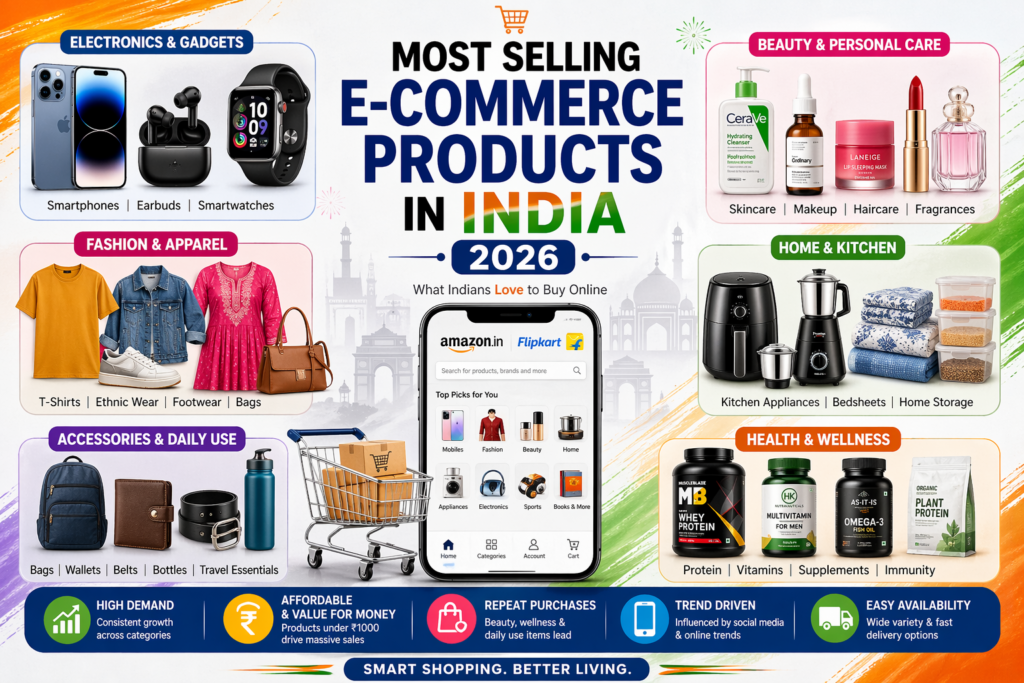
Why Shipping Costs Matter More Than Most Sellers Realise
India’s digital commerce market is set to cross $350 billion by 2030, and competition across every product category is intensifying. On thin margins, the difference between a profitable order and a loss-making one often comes down to three things: shipping cost, packaging weight, and whether the customer returns the product.
In India, 81% of shoppers returned something they bought online in the past year — significantly higher than most other major markets. And the average ecommerce return rate in 2026 is 19–20.5% across all product categories, with costs to process each return running anywhere from 20% to 65% of the item’s original value.
The categories below are ranked by demand — but each section also includes a quick shipping snapshot: typical weight, estimated courier cost, and return risk. Use this to choose not just what sells, but what ships profitably.
1. Clothing & Apparel
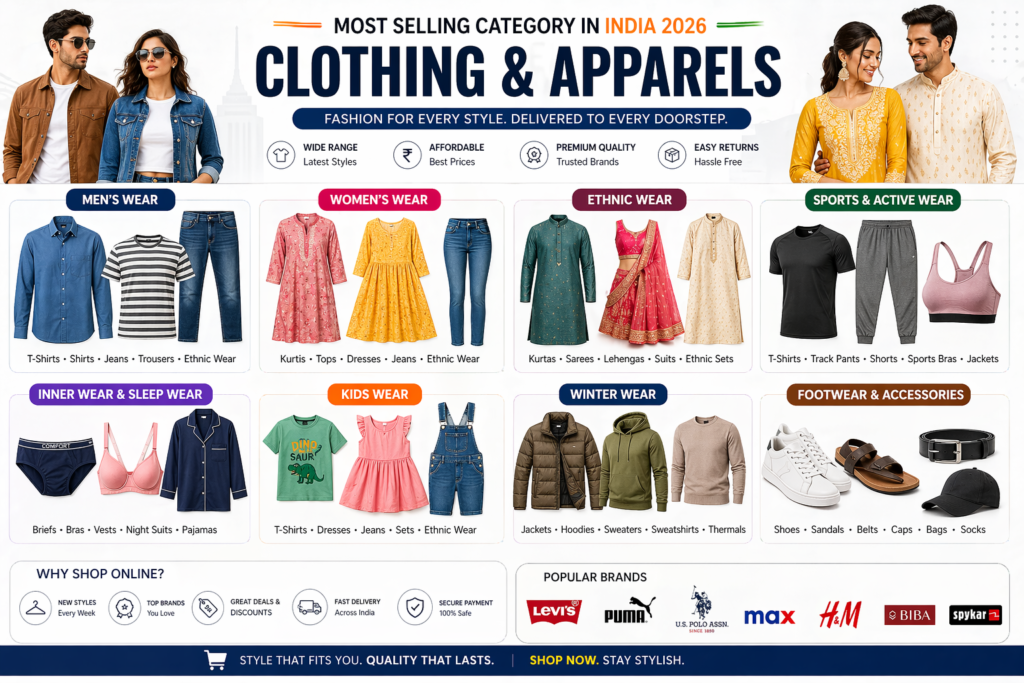
Demand level: ⭐⭐⭐⭐⭐ (Highest)
Close to 35% of the total revenue from online sales comes from clothing and apparel, making it the single largest product category in Indian e-commerce. Clothing continues to dominate Indian eCommerce due to fast-changing fashion cycles, climate-specific needs, and a strong shift toward comfort and value. Cotton t-shirts, casual shirts, athleisure wear, and ethnic wear consistently drive strong order volumes throughout the year.
The shipping reality:
Clothing is one of the easiest categories to ship — most garments weigh between 200g and 500g, keeping you in the lowest courier charge slabs. A single t-shirt typically ships for ₹50–₹100 depending on the courier and zone. Even bulkier items like jackets or denim rarely exceed 1 kg, keeping interstate shipping costs under ₹150 on most platforms.
The bigger challenge is returns. Clothes consistently have the highest return rates in online retail, usually hitting 20–30%, because of fit issues, colour differences, and customers buying multiple sizes with plans to return what doesn’t fit. In India, where size standardisation is inconsistent across brands, this problem is even more pronounced.
Shipping tips for apparel sellers:
- Use poly mailer bags instead of boxes — they’re lighter, cheaper, and perfectly suited for garments
- Add clear size charts and real-model photos to reduce fit-related returns
- Consider enabling exchange (instead of just returns) to reduce reverse logistics costs
- Use a courier aggregator to compare rates — on 50+ shipments/month, even ₹10–₹15 saved per shipment adds up to ₹6,000–₹9,000/month
2. Mobile Phones & Accessories
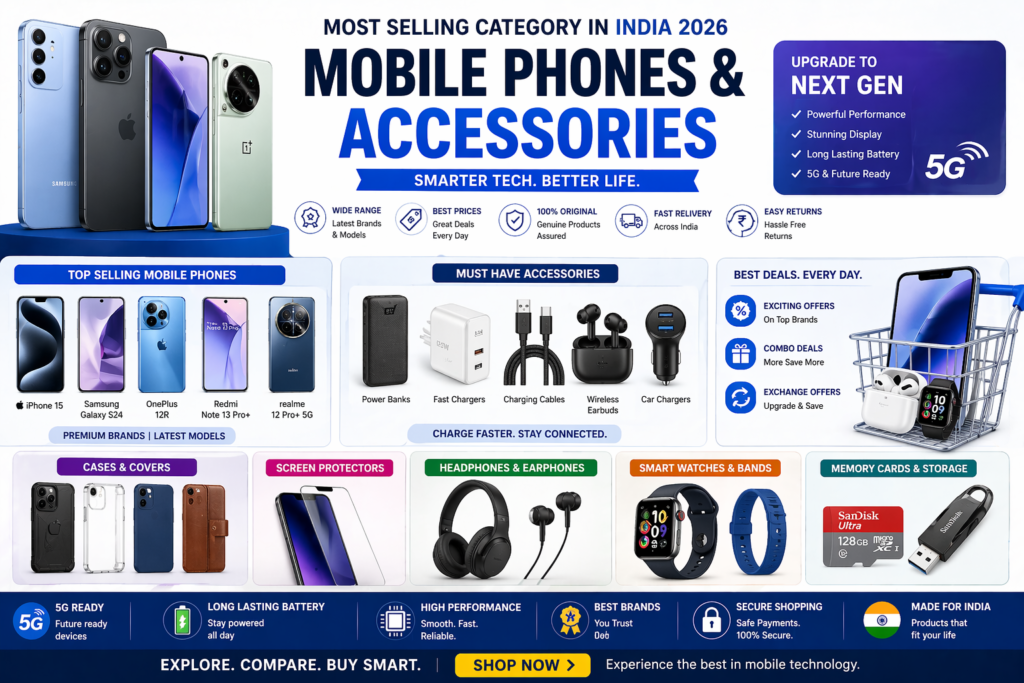
Demand level: ⭐⭐⭐⭐⭐
Mobile phones are among the most demanded products in India, with 600 million smartphones sold across India as of 2022. Beyond handsets, the accessories ecosystem — phone cases, screen protectors, chargers, cables, earphones, and power banks — is a massive opportunity for small sellers with lower investment requirements.
The shipping reality:
Mobile accessories are a logistics dream. Most accessories weigh under 200g, fit in small boxes, and ship for ₹50–₹80 intra-city or ₹100–₹130 interstate. Margins on accessories are high and return rates are relatively low compared to apparel — electronics as a category see an average return rate of around 11%, significantly lower than fashion.
Full smartphones are trickier. They require declared-value insurance, careful packaging, and often attract higher courier surcharges. Most sellers on marketplaces like Flipkart and Amazon rely on the platform’s logistics for handset shipping.
Shipping tips for mobile accessory sellers:
- Use rigid bubble-lined mailers for small accessories — protects the product without adding box weight
- Declare accurate product value to avoid claim issues in transit
- For COD orders on higher-value accessories, set a minimum order threshold to reduce failed delivery rates
3. Skincare & Beauty Products

Demand level: ⭐⭐⭐⭐⭐
The Indian male grooming products market is on a rapid growth trajectory, and self-care and beauty continue to dominate online sales across both men’s and women’s segments. Skincare, haircare, and personal grooming products see strong repeat purchase behaviour, making them ideal for building a subscription-style D2C brand.
The shipping reality:
Beauty products present a packaging challenge. Liquids, creams, and glass bottles require proper cushioning and leak-proof packaging — which adds weight and cost. A skincare set that weighs 300g as a product can easily reach 600g–800g once packaged safely, pushing you into the next weight slab.
The good news: beauty and personal care products have some of the lowest return rates at around 1–5%, since most customers know they can’t return opened products. This makes beauty one of the most profitable categories from a logistics standpoint.
Shipping tips for beauty sellers:
- Use bubble wrap inserts or foam padding inside the box — not just around it
- Seal liquid products with tape before boxing to prevent leakage claims
- Optimise box size tightly — an oversized box can trigger volumetric weight charges even for lightweight products
- If you’re shipping 20+ orders/day, negotiate a dedicated rate card with your courier partner through a shipping aggregator
4. Health, Fitness & Wellness Products
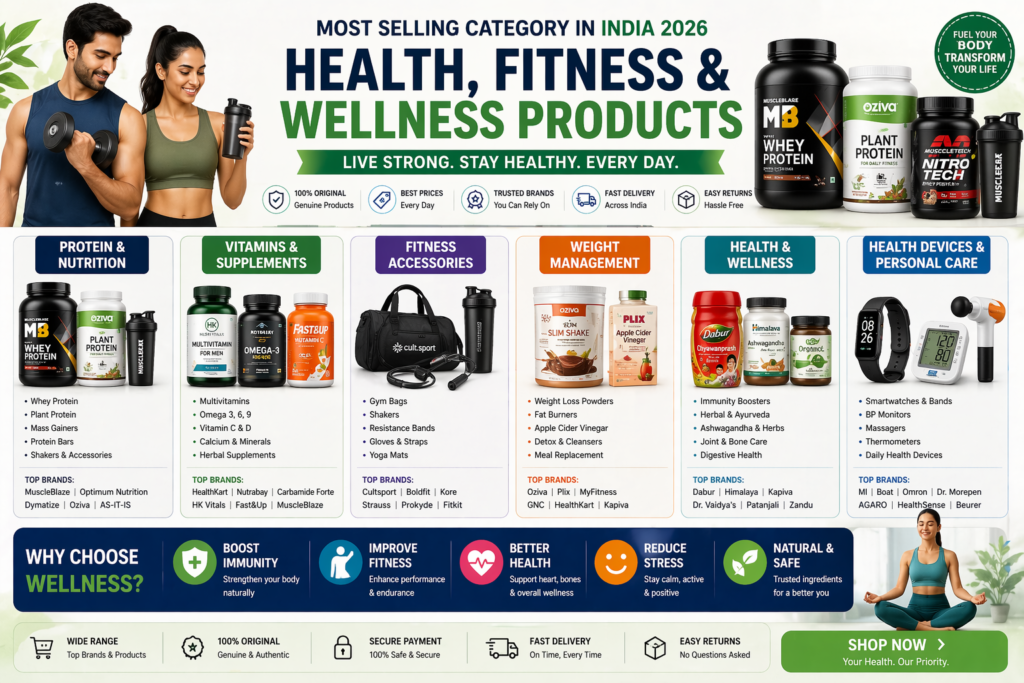
Demand level: ⭐⭐⭐⭐
The demand for wellness products is shifting toward everyday items like vegan protein, plant-based supplements, immunity boosters, and gut health products, with younger Indians adopting healthier lifestyles. Fitness equipment — resistance bands, yoga mats, dumbbells, and smartwatches — has also seen sustained demand post-pandemic.
The shipping reality:
This category is wide, and shipping costs vary dramatically within it. Supplements in pouch or bottle form are compact and ship easily. Yoga mats and fitness equipment are a different story — a single yoga mat weighs 1–1.5 kg and is bulky enough to trigger volumetric weight calculations, meaning you could be billed for 3–4 kg on a 1.2 kg product.
Smartwatches and fitness trackers are lightweight but require careful packaging and insurance for higher-value SKUs.
Shipping tips for health & fitness sellers:
- For supplements, use stand-up pouches over glass bottles wherever possible — same product, 40–60% less packaging weight
- For yoga mats and gym equipment, always calculate volumetric weight before listing your shipping price (Length × Breadth × Height ÷ 5000)
- Build shipping cost into your product price for bulky fitness items — don’t offer free shipping on items where courier costs exceed ₹150
5. Home Décor & Kitchen Products

Demand level: ⭐⭐⭐⭐
Home decoration products are trending due to social media inspiration and interior design trends, widely promoted on Instagram and Pinterest. Unique kitchen tools attract strong interest from online shoppers and often perform well in short-form video marketing. Air fryers, induction cooktops, decorative items, and smart home gadgets are all seeing sustained demand.
The shipping reality:
This is one of the most challenging categories to ship profitably. Home décor items are often fragile, oddly shaped, and heavy — a combination that drives up both packaging costs and courier charges. A ceramic vase that weighs 500g might need ₹80 worth of bubble wrap, a double-walled box, and still ship at 1.5 kg volumetric weight.
Damage-in-transit is a real risk, and claims can be time-consuming. Return rates for home goods sit in the 10–15% range, often triggered by breakage or products that look different from listing photos.
Shipping tips for home décor sellers:
- Use double-wall corrugated boxes for fragile items — the extra cost is worth it versus claims and re-shipments
- Always opt for carrier insurance on orders above ₹500
- List realistic product dimensions and photos — it reduces expectation-gap returns
- Consider limiting free shipping to orders above a threshold (e.g., ₹599) to recover shipping cost on lower-value décor items
6. Baby Care Products
Demand level: ⭐⭐⭐⭐
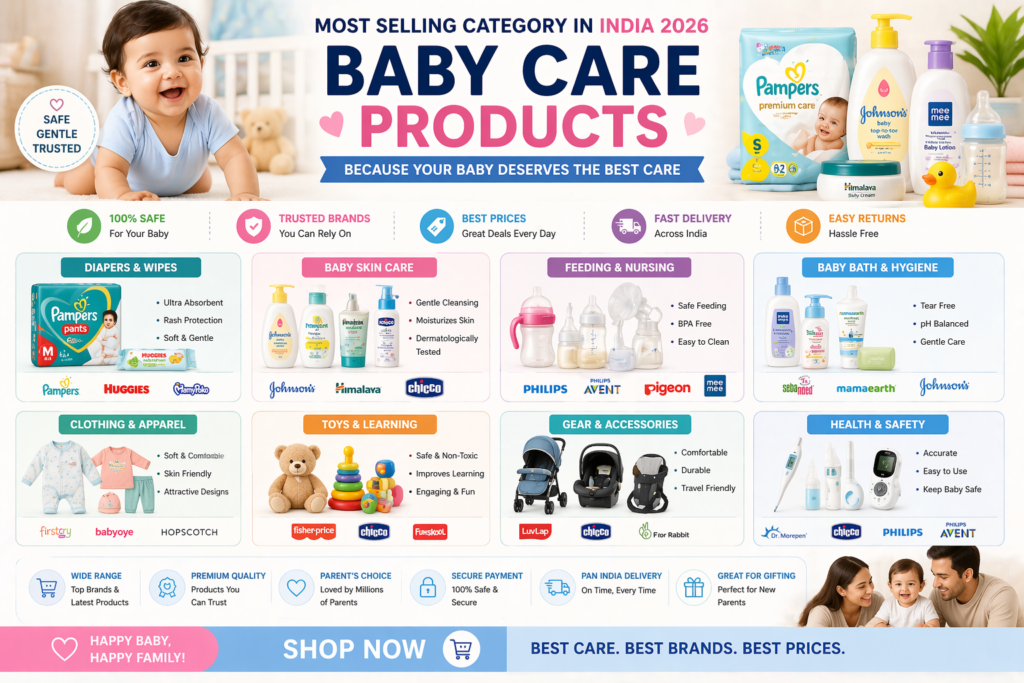
The baby care products market in India was worth USD 12.73 billion in 2022 and is expected to grow at a CAGR of 17.25% to reach USD 38.51 billion by 2029. Diapers, feeding accessories, baby grooming kits, and safety products are consistent bestsellers across all major platforms.
The shipping reality:
Baby products span a huge range. Diapers are bulky and low-value per unit — not ideal for D2C shipping unless you’re moving in bulk. Baby grooming kits, feeding accessories, and clothing are lightweight and ship cheaply, often under ₹80 per order.
Parents tend to be highly brand-loyal once trust is established, making repeat purchases common. Return rates in this category are moderate — products rarely come back unless there’s a quality issue.
Shipping tips for baby care sellers:
- Bundle small accessories (feeding spoons, bibs, bottle brushes) into gift sets — higher order value, same shipping cost
- For bulkier products like diapers, consider a subscription model with periodic dispatches to reduce per-unit shipping cost
- Use tamper-evident seals on feeding and hygiene products — customers trust sealed items and return rates drop
7. Fashion Accessories & Jewellery

Demand level: ⭐⭐⭐⭐
Fashion accessories are a popular product category sold online — belts, handbags, purses, wallets, watches, and trending items like scrunchies, chokers, and midi rings are widely bought online, especially by younger consumers.
The shipping reality:
Jewellery and accessories are among the most logistics-friendly categories to ship — most items weigh under 200g and ship for ₹50–₹80 domestically. Margins can be strong, especially for fashion jewellery with low COGS.
The catch is declared value and insurance. For higher-value pieces (silver, gold-plated), underdeclaring value to save on insurance is a common mistake that costs sellers dearly when claims arise. Also, when asked about the most returned purchases by category, bags and accessories came second after clothing, with 19% of consumers choosing this answer.
Shipping tips for accessories sellers:
- Use rigid small boxes for jewellery — poly mailers risk deforming delicate items
- Declare accurate product value and opt for carrier insurance on orders above ₹300
- Use a personalised unboxing experience (tissue paper, thank-you card) — it reduces impulse returns and drives repeat purchases
8. Books & Stationery
Demand level: ⭐⭐⭐
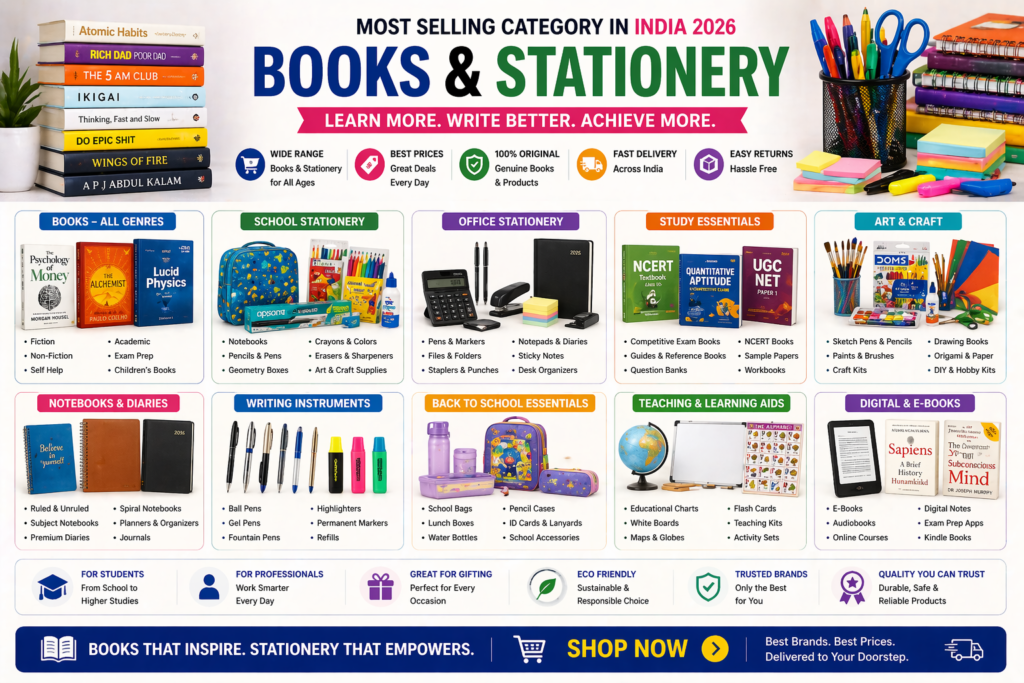
Books remain a reliable seller on Indian e-commerce platforms. Educational, self-help, and competitive exam preparation titles consistently rank among the top items on Amazon India and Flipkart. The growth of homeschooling and online learning has expanded demand beyond traditional categories.
The shipping reality:
Books are one of the easiest and most cost-effective products to ship in India. A single paperback weighs 200–400g. India Post’s Book Parcel service offers rates 30–40% cheaper than standard parcel rates for printed materials. Return rates are extremely low.
Shipping tips for book sellers:
- Use India Post’s Book Parcel service for single-title shipments — it’s significantly cheaper than private couriers
- Wrap books in kraft paper or padded envelopes to prevent corner damage in transit
- For bundles (exam prep kits, curated book sets), private couriers offer better tracking and delivery speed
The Shipping Snapshot: All Categories at a Glance
| Category | Typical Ship Weight | Approx. Shipping Cost | Return Rate | Shipping Difficulty |
| Clothing & Apparel | 200–500g | ₹60–₹130 | High (20–30%) | Low |
| Mobile Accessories | 100–300g | ₹50–₹110 | Low (8–11%) | Low |
| Skincare & Beauty | 300–800g (packed) | ₹80–₹160 | Very Low (1–5%) | Medium |
| Health & Fitness | 500g–3kg | ₹100–₹350 | Low–Medium | Medium |
| Home Décor & Kitchen | 500g–3kg+ | ₹120–₹400+ | Medium (10–15%) | High |
| Baby Care | 200g–2kg | ₹70–₹250 | Low–Medium | Low–Medium |
| Fashion Accessories | 100–300g | ₹50–₹100 | Medium (15–20%) | Low |
| Books & Stationery | 200–500g | ₹40–₹80 | Very Low | Very Low |
How to Choose the Right Courier for Your Product
Once you know what you’re selling, the next question is which courier to use. There’s no single right answer because the best courier depends on your product weight, destination pin code, COD requirements, and monthly shipment volume.
Here’s a quick starting framework:
- Light products (under 500g), urban routes → DTDC Lite, Delhivery, or XpressBees offer competitive rates
- Heavier products or rural destinations → India Post or Speed Post often beats private couriers on price
- High-value products → Always opt for a courier with real-time tracking and built-in insurance
- High COD volume → Choose a courier with next-day or T+1 COD remittance to improve your cash flow
The smartest move, especially when you’re scaling, is to not commit to a single courier. Different pin codes and weight slabs have different best options — sometimes the same shipment is ₹30 cheaper on one courier versus another just based on the destination zone.
Stop Overpaying on Shipping
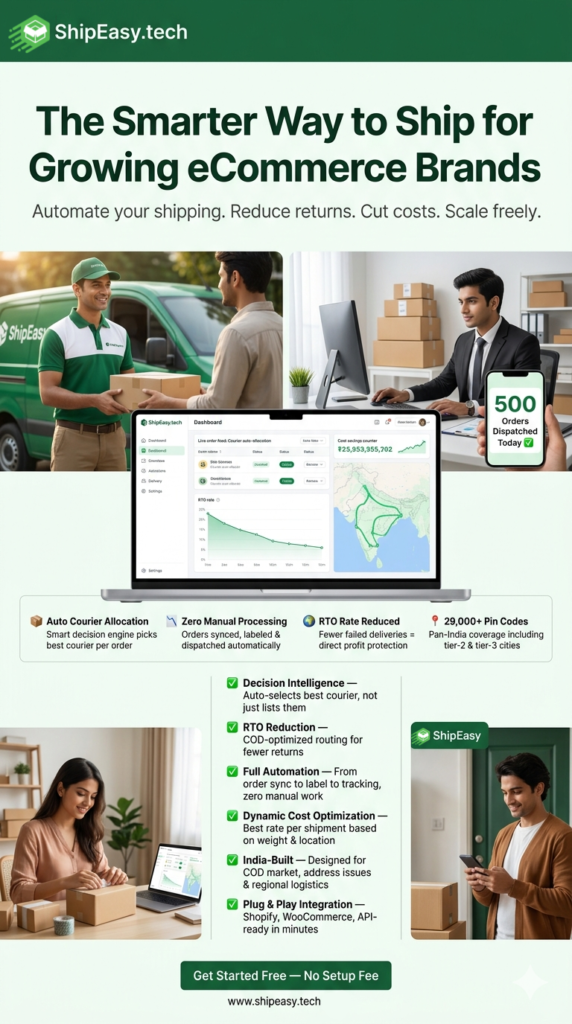
ShipEasy is a courier aggregator built for Indian e-commerce sellers. Instead of locking into one courier, you get instant rate comparison across 15+ partners — DTDC, Delhivery, XpressBees, India Post, and more — every time you ship.
What sellers use ShipEasy for:
- Rate comparison: See all courier rates side-by-side before you book, for any weight and pin code
- Automatic best-rate selection: Let the platform pick the cheapest option for each order
- COD management: Single dashboard for all COD collections and remittances
- NDR & RTO automation: Reduce failed deliveries and reverse logistics costs
- Bulk shipping: Process hundreds of orders in minutes with a single CSV upload
Whether you’re just starting out with 20 orders a month or scaling to thousands, shipping smarter starts with comparing rates first.
👉 Start comparing courier rates free on ShipEasy → shipeasy.tech
Frequently Asked Questions
What are the most selling products in India online in 2026?
The highest-demand categories are clothing and apparel, mobile phones and accessories, skincare and beauty, health and wellness products, and home décor. Apparel alone accounts for around 35% of all online sales revenue in India.
Which product category has the lowest return rate in Indian e-commerce?
Beauty and personal care products have the lowest return rates, typically between 1–5%, because customers know opened products generally can’t be returned. Books and stationery also see very low returns.
What is the cheapest product to ship in India?
Lightweight, non-fragile items like fashion accessories, mobile accessories, and books are the cheapest to ship — typically under ₹100 for most domestic routes. Apparel in poly mailers is similarly cost-effective.
How do I reduce return rates for my online store?
The most effective strategies are accurate product descriptions, real-model sizing photos for apparel, clear dimension information for home products, and tamper-evident packaging for health and beauty items. Offering exchanges instead of returns also reduces net reverse logistics volume.
How can I compare courier charges before shipping?
Use a courier aggregator like ShipEasy to compare live rates across 15+ courier partners before every shipment. Enter your origin and destination pin codes, product weight, and order value — and you’ll see the cheapest and fastest options side by side.
Shipping cost estimates in this article are indicative figures based on publicly available rate data as of April 2026. Actual rates vary by courier, route, service level, volumetric weight, and GST. Use ShipEasy’s rate calculator for real-time quotes.