A casino website can look convincing in seconds; establishing whether it deserves your time takes closer inspection. For players comparing online gaming options, the useful questions are practical: which games are available, how clearly are payments explained, and what safeguards support responsible play? A careful review of Aus55 should begin with those checks rather than promotional claims.
Use this guide alongside the operator’s current terms and account information, and visit https://aus55.org/ only after confirming that access is lawful where you live. Availability, features, and eligibility can vary by jurisdiction, so verify the details displayed to you before registering or depositing.
What to Check Before Creating an Account
Start with the basic signals of a trustworthy service. Look for a clearly identified operating company, licensing information that can be independently verified, accessible terms, and a privacy policy explaining how account and payment data are handled. A polished design alone does not establish that a casino is regulated or that its claims are accurate.
Read the rules that affect your money before accepting a welcome offer. Bonus terms may set minimum deposits, wagering requirements, eligible games, maximum bet limits, and withdrawal caps. The headline amount is only one part of the offer: restrictions can determine whether the promotion is useful or whether winnings become difficult to withdraw.
Confirm the legal operator and check any stated licence with the regulator’s own records.
Review age, identity, and location requirements before submitting personal documents.
Find the full bonus terms, including expiry dates and excluded games.
Check withdrawal methods, processing estimates, fees, and verification procedures.
Locate customer support and responsible-gambling controls before funding an account.
Games, Payments, and Usability
A well-organised lobby helps players compare categories without confusing entertainment with value. Slots, table games, and live dealer titles may be grouped by provider or game type, but availability can depend on location. Check whether each game displays its rules and paytable, and remember that published return-to-player figures are theoretical long-run estimates, not promises about an individual session.
Payment convenience depends on more than the deposit screen. Before transferring funds, confirm that the payment method is supported for both deposits and withdrawals, whether account names must match, and what documentation might be requested. A deposit that appears instantly does not mean a cash-out will be equally fast; review the stated processing window and any bank or provider delays.
Area
What to verify
Why it matters
Games
Rules, providers, availability, and stated RTP
Supports informed selection without implying guaranteed returns
Bonuses
Wagering, expiry, eligible titles, and caps
Reveals the real conditions attached to promotional funds
Payments
Supported methods, fees, limits, and timelines
Helps prevent avoidable delays or incompatible transactions
Account security
Verification steps, privacy terms, and support access
Clarifies how personal information and account access are managed
How to Judge Value Without Chasing Bonuses
Commercial offers can make a casino seem more attractive, but value should be assessed against restrictions and personal limits. Compare the wagering requirement with the bonus amount, then check which bets count and whether maximum stakes apply while wagering. If the terms are difficult to locate or interpret, that uncertainty is a reason to pause rather than deposit quickly.
Consider the overall experience as well: clear navigation, accurate game information, transparent transaction rules, and responsive support are more useful than a large promotional figure on its own. If you contact support, keep a record of the question and response, especially for bonus eligibility, verification, or pending withdrawals. This creates a practical reference if the account terms are later disputed.
Risk Controls and a Sensible Playing Plan
Casino games involve financial risk, and outcomes are uncertain. Treat play as paid entertainment, not as a way to earn income or recover losses. Decide in advance how much time and money you can afford to spend, and stop when either limit is reached. Do not borrow to gamble, raise stakes to chase a loss, or interpret a short winning run as evidence of a dependable strategy.
Set a deposit limit before playing and keep essential bills separate.
Use time-outs or self-exclusion if gambling begins to affect wellbeing or responsibilities.
Take breaks and avoid playing when distressed, impaired, or under pressure.
Seek local professional support if gambling feels difficult to control.
Final Assessment: Make an Informed Choice
Aus55 may suit players who can verify its legal availability, understand its current terms, and find the games and payment options they need. The decision should rest on evidence available in the account’s official information, not assumptions based on branding or advertising. If licence details, withdrawal conditions, or support policies remain unclear, do not deposit until they are resolved.
Before registering, compare the platform against your own priorities: transparent rules, accessible safeguards, reliable account support, and manageable spending controls. A measured review takes longer than responding to a promotion, but it gives you a better basis for deciding whether the service is appropriate—and whether walking away is the wiser option.
Un’interfaccia curata può attirare l’attenzione, ma non basta a dimostrare che una piattaforma di gioco sia adatta alle proprie esigenze. Per orientarsi tra offerte, giochi e strumenti disponibili, conviene osservare con metodo gli aspetti che incidono davvero sull’esperienza: trasparenza, sicurezza, assistenza e gestione del tempo.
Una prima ricognizione su highflybet può essere l’occasione per capire come si presenta un operatore e quali informazioni mette a disposizione. Prima di registrarsi o effettuare un deposito, è comunque opportuno controllare ogni condizione direttamente sul sito e verificare che l’offerta sia accessibile nel proprio territorio.
La trasparenza viene prima delle promozioni
Bonus e tornei sono spesso in evidenza, ma il loro valore dipende dalle regole associate. Una promozione chiara indica a chi è rivolta, entro quando va attivata, quali giochi partecipano e quali requisiti di puntata occorre soddisfare. Se questi dettagli sono difficili da trovare, è prudente rimandare l’adesione e chiedere chiarimenti all’assistenza.
Leggere le condizioni aiuta anche a distinguere il credito promozionale dal saldo prelevabile. Alcune offerte prevedono limiti di puntata, una scadenza breve o restrizioni sui prelievi fino al completamento dei requisiti. Non è necessario accettare un bonus per iniziare a giocare: confrontare l’esperienza con e senza promozione può essere una scelta sensata.
Verificare il requisito di puntata e i giochi che contribuiscono al suo completamento.
Controllare validità, importo massimo e limiti applicati alle scommesse.
Leggere le regole di prelievo e l’eventuale procedura per rinunciare all’offerta.
Non considerare una promozione come garanzia di vincita o di recupero delle perdite.
Licenza, protezione e gestione dell’account
Per chi si trova in Italia, la verifica della regolarità dell’operatore è un passaggio essenziale. Occorre cercare riferimenti alla licenza e controllare le informazioni attraverso i canali istituzionali competenti, senza affidarsi soltanto a loghi, annunci pubblicitari o recensioni di terzi. Le regole possono cambiare: una verifica aggiornata è più utile di una valutazione basata su notizie datate.
Anche la protezione dell’account merita attenzione. Una connessione cifrata, procedure di accesso affidabili, comunicazioni comprensibili e una politica sulla riservatezza facilmente consultabile sono elementi da valutare insieme. Durante la registrazione, fornire soltanto dati richiesti e coerenti con le procedure di verifica; non condividere password o codici temporanei, nemmeno con persone che si presentano come operatori del servizio.
Le verifiche d’identità possono essere richieste per confermare i dati o elaborare determinate operazioni. È utile informarsi in anticipo sui documenti accettati, sui tempi indicativi e sui canali sicuri per inviarli. In caso di discrepanze tra le informazioni inserite e i documenti, contattare l’assistenza prima di ripetere la procedura.
Confronto pratico dei principali elementi
Una tabella sintetica aiuta a mettere in ordine le domande prima di scegliere. Non assegna un punteggio universale: il peso di ciascun criterio dipende dalle necessità personali e dalle norme applicabili.
Elemento
Che cosa controllare
Perché è utile
Regolarità
Licenza e riferimenti verificabili
Consente di valutare il quadro normativo
Pagamenti
Metodi, limiti e tempi dichiarati
Riduce le sorprese nelle operazioni
Assistenza
Canali, orari e chiarezza delle risposte
Aiuta a risolvere dubbi e problemi
Catalogo
Tipologie, fornitori e informazioni sui giochi
Facilita la scelta in base alle preferenze
Strumenti personali
Limiti, pause e autoesclusione
Favorisce un uso più controllato
Pagamenti e assistenza: leggere le condizioni concrete
La presenza di un metodo di pagamento familiare non racconta tutta la storia. Prima di procedere, confrontare importi minimi e massimi, eventuali commissioni, tempi di accredito e condizioni per il prelievo. Le tempistiche possono variare in base al metodo scelto e ai controlli necessari; è meglio considerare i dati pubblicati come indicazioni da verificare, non come una promessa universale.
Un’assistenza valida dovrebbe spiegare i passaggi in modo comprensibile e indicare dove trovare le condizioni pertinenti. Prima di aprire una richiesta, annotare l’eventuale numero di riferimento e descrivere il problema senza trasmettere informazioni sensibili non necessarie. Conservare le comunicazioni può rendere più semplice seguire un caso che richiede più di un contatto.
Un metodo rapido per prendere una decisione
Per confrontare più operatori, si può usare una procedura in tre passaggi: leggere le condizioni principali, verificare la licenza tramite fonti attendibili e testare la qualità delle informazioni disponibili prima di depositare. Se un punto resta ambiguo, chiedere chiarimenti e aspettare una risposta concreta è preferibile a decidere sotto la pressione di una scadenza promozionale.
Il gioco responsabile fa parte della valutazione
Una piattaforma da prendere in considerazione dovrebbe presentare strumenti per impostare limiti di deposito o di sessione, fare una pausa e, quando necessario, richiedere l’autoesclusione. Consultare le modalità di attivazione e capire come funzionano prima di averne bisogno. Queste funzioni non eliminano i rischi, ma possono aiutare a mantenere il gioco entro confini stabiliti in anticipo.
Definire un budget che ci si può permettere di perdere e un limite di tempo è una precauzione fondamentale. Il gioco non dovrebbe essere usato per affrontare difficoltà economiche, inseguire perdite o cercare un reddito. Se diventa difficile fermarsi o incide sul benessere e sulle relazioni, interrompere l’attività e rivolgersi a servizi qualificati per ricevere supporto.
Una valutazione accurata nasce quindi dall’insieme dei dettagli, non da una singola offerta o da un catalogo ampio. Condizioni leggibili, informazioni verificabili, procedure di pagamento comprensibili e strumenti di tutela costituiscono una base più solida per decidere. Prendersi il tempo di confrontarli permette di scegliere con maggiore consapevolezza e di rinunciare quando qualcosa non convince.
Lorem ipsum dolor sit amet consectetur adipiscing elit. Quisque faucibus ex sapien vitae pellentesque sem placerat. In id cursus mi pretium tellus duis convallis. Tempus leo eu aenean sed diam urna tempor. Pulvinar vivamus fringilla lacus nec metus bibendum egestas. Iaculis massa nisl malesuada lacinia integer nunc posuere. Ut hendrerit semper vel class aptent taciti sociosqu. Ad litora torquent per conubia nostra inceptos himenaeos.
Lorem ipsum dolor sit amet consectetur adipiscing elit. Quisque faucibus ex sapien vitae pellentesque sem placerat. In id cursus mi pretium tellus duis convallis. Tempus leo eu aenean sed diam urna tempor. Pulvinar vivamus fringilla lacus nec metus bibendum egestas. Iaculis massa nisl malesuada lacinia integer nunc posuere. Ut hendrerit semper vel class aptent taciti sociosqu. Ad litora torquent per conubia nostra inceptos himenaeos.
Lorem ipsum dolor sit Non Existing amet consectetur adipiscing elit. Quisque faucibus ex sapien vitae pellentesque sem placerat. In id cursus mi pretium tellus duis convallis. Tempus leo eu aenean sed diam urna tempor. Pulvinar vivamus fringilla lacus nec metus bibendum egestas. Iaculis massa nisl malesuada lacinia integer nunc posuere. Ut hendrerit semper vel class aptent taciti sociosqu. Ad litora torquent per conubia nostra inceptos himenaeos.
Lorem ipsum dolor sit amet consectetur adipiscing elit. Quisque faucibus ex sapien vitae pellentesque sem placerat. In id cursus mi pretium tellus duis convallis. Tempus leo eu aenean sed diam urna tempor. Pulvinar vivamus fringilla lacus nec metus bibendum egestas. Iaculis massa nisl malesuada lacinia integer nunc posuere. Ut hendrerit semper vel class aptent taciti sociosqu. Ad litora torquent per conubia nostra inceptos himenaeos.
Lorem ipsum dolor sit amet consectetur adipiscing elit. Quisque faucibus ex sapien vitae pellentesque sem placerat. In id cursus mi pretium tellus duis convallis. Tempus leo eu aenean sed diam urna tempor. Pulvinar vivamus fringilla lacus nec metus bibendum egestas. Iaculis massa nisl malesuada lacinia integer nunc posuere. Ut hendrerit semper vel class aptent taciti sociosqu. Ad litora torquent per conubia nostra inceptos himenaeos.
Lorem ipsum dolor sit amet consectetur adipiscing elit. Quisque faucibus ex sapien vitae pellentesque sem placerat. In id cursus mi pretium tellus duis convallis. Tempus leo eu aenean sed diam urna tempor. Pulvinar vivamus fringilla lacus nec metus bibendum egestas. Iaculis massa nisl malesuada lacinia integer nunc posuere. Ut hendrerit semper vel class aptent taciti sociosqu. Ad litora torquent per conubia nostra inceptos himenaeos.
Lorem ipsum dolor sit amet consectetur adipiscing elit. Quisque faucibus ex sapien vitae pellentesque sem placerat. In id cursus mi pretium tellus duis convallis. Tempus leo eu aenean sed diam urna tempor. Pulvinar vivamus fringilla lacus nec metus bibendum egestas. Iaculis massa nisl malesuada lacinia integer nunc posuere. Ut hendrerit semper vel class aptent taciti sociosqu. Ad litora torquent per conubia nostra inceptos himenaeos.
Lorem ipsum dolor sit amet consectetur adipiscing elit. Quisque faucibus ex sapien vitae pellentesque sem placerat. In id cursus mi pretium tellus duis convallis. Tempus leo eu aenean sed diam urna tempor. Pulvinar vivamus fringilla lacus nec metus bibendum egestas. Iaculis massa nisl malesuada lacinia integer nunc posuere. Ut hendrerit semper vel class aptent taciti sociosqu. Ad litora torquent per conubia nostra inceptos himenaeos.
Lorem ipsum dolor sit amet consectetur adipiscing elit. Quisque faucibus ex sapien vitae pellentesque sem placerat. In id cursus mi pretium tellus duis convallis. Tempus leo eu aenean sed diam urna tempor. Pulvinar vivamus fringilla lacus nec metus bibendum egestas. Iaculis massa nisl malesuada lacinia integer nunc posuere. Ut hendrerit semper vel class aptent taciti sociosqu. Ad litora torquent per conubia nostra inceptos himenaeos.
Lorem ipsum dolor sit amet consectetur adipiscing elit. Quisque faucibus ex sapien vitae pellentesque sem placerat. In id cursus mi pretium tellus duis convallis. Tempus leo eu aenean sed diam urna tempor. Pulvinar vivamus fringilla lacus nec metus bibendum egestas. Iaculis massa nisl malesuada lacinia integer nunc posuere. Ut hendrerit semper vel class aptent taciti sociosqu. Ad litora torquent per conubia nostra inceptos himenaeos.
Lorem ipsum dolor sit amet consectetur adipiscing elit. Quisque faucibus ex sapien vitae pellentesque sem placerat. In id cursus mi pretium tellus duis convallis. Tempus leo eu aenean sed diam urna tempor. Pulvinar vivamus fringilla lacus nec metus bibendum egestas. Iaculis massa nisl malesuada lacinia integer nunc posuere. Ut hendrerit semper vel class aptent taciti sociosqu. Ad litora torquent per conubia nostra inceptos himenaeos.
Lorem ipsum dolor sit amet consectetur adipiscing elit. Quisque faucibus ex sapien vitae pellentesque sem placerat. In id cursus mi pretium tellus duis convallis. Tempus leo eu aenean sed diam urna tempor. Pulvinar vivamus fringilla lacus nec metus bibendum egestas. Iaculis massa nisl malesuada lacinia integer nunc posuere. Ut hendrerit semper vel class aptent taciti sociosqu. Ad litora torquent per conubia nostra inceptos himenaeos.
Lorem ipsum dolor sit amet consectetur adipiscing elit. Quisque faucibus ex sapien vitae pellentesque sem placerat. In id cursus mi pretium tellus duis convallis. Tempus leo eu aenean sed diam urna tempor. Pulvinar vivamus fringilla lacus nec metus bibendum egestas. Iaculis massa nisl malesuada lacinia integer nunc posuere. Ut hendrerit semper vel class aptent taciti sociosqu. Ad litora torquent per conubia nostra inceptos himenaeos.
Lorem ipsum dolor sit amet consectetur adipiscing elit. Quisque faucibus ex sapien vitae pellentesque sem placerat. In id cursus mi pretium tellus duis convallis. Tempus leo eu aenean sed diam urna tempor. Pulvinar vivamus fringilla lacus nec metus bibendum egestas. Iaculis massa nisl malesuada lacinia integer nunc posuere. Ut hendrerit semper vel class aptent taciti sociosqu. Ad litora torquent per conubia nostra inceptos himenaeos.
Lorem ipsum dolor sit amet consectetur adipiscing elit. Quisque faucibus ex sapien vitae pellentesque sem placerat. In id cursus mi pretium tellus duis convallis. Tempus leo eu aenean sed diam urna tempor. Pulvinar vivamus fringilla lacus nec metus bibendum egestas. Iaculis massa nisl malesuada lacinia integer nunc posuere. Ut hendrerit semper vel class aptent taciti sociosqu. Ad litora torquent per conubia nostra inceptos himenaeos.
Businesses and consumers alike depend significantly on effective logistics in the fast-paced, digitally-driven economy of today. By guaranteeing the prompt and effective delivery of goods, courier services are essential in bridging the gap between companies and their clients. Aggregator courier services have become a disruptive force in the courier sector due to the increased need for logistical solutions. However, what makes aggregator courier services superior to conventional courier services?
This blog explores the concept of aggregator courier services, their advantages, and how they revolutionize the logistics landscape to meet the needs of businesses and consumers alike.
Table of Contents
What Are Aggregator Courier Services?
Platforms that combine several courier and delivery services under one digital roof are known as aggregator courier services. These services use cutting-edge technology to give customers access to a network of courier services, resulting in cost-effectiveness, flexibility, and convenience.
Unlike traditional courier companies that rely on fixed networks and infrastructure, aggregators operate as intermediaries, connecting customers with the most suitable courier partner for their specific needs. Think of it as a “marketplace” for logistics, much like how ride-hailing apps revolutionized personal transportation.
The Rise of Aggregator Courier Services
The logistics industry has evolved dramatically over the last decade, driven by e-commerce growth, consumer demand for faster delivery, and technological advancements. Traditional courier companies often struggle to scale their operations to meet this growing demand, especially in underserved or remote areas.
Aggregator courier services emerged to fill these gaps by offering scalable, data-driven solutions integrating multiple service providers. By leveraging AI, machine learning, and real-time tracking, these platforms ensure seamless deliveries tailored to various customer requirements.
Top Reasons to Choose Aggregator Courier Services
1. Cost-Effectiveness
One of the primary advantages of using aggregator courier services is the cost savings they offer. Aggregators collaborate with multiple courier companies, which allows them to negotiate competitive rates. Customers benefit by choosing the most affordable option without compromising on service quality.
Moreover, businesses can reduce logistics overheads by outsourcing deliveries to aggregators rather than maintaining an in-house fleet. This flexibility is particularly valuable for small and medium-sized enterprises (SMEs) that need cost-effective logistics solutions.
2. Wide Network Coverage
Aggregator platforms often partner with numerous local, national, and international courier companies, offering unparalleled network coverage. Whether you need to send a package to a bustling metropolitan area or a remote village, these platforms can connect you with a courier partner capable of handling the delivery.
This wide reach ensures businesses can expand their operations to new markets without worrying about logistics constraints.
3. Customizable Options
Aggregator courier services cater to diverse shipping needs by offering customizable delivery options. Businesses can select services based on:
Speed: Same-day, next-day, or standard delivery options.
Package type: Documents, parcels, fragile items, or oversized goods.
Mode of transport: Road, air, or sea freight.
This level of customization allows businesses to optimize their logistics strategy based on urgency, cost, and type of goods.
4. Technological Advancements
Aggregator platforms leverage cutting-edge technology to provide a superior user experience. Key technological features include:
Real-time tracking: Customers can monitor their shipments at every stage of the delivery process.
AI-powered recommendations: Platforms suggest the best courier partner based on delivery requirements, cost, and timelines.
Automated processes: From booking to payment, the entire process is streamlined to reduce manual intervention.
These innovations not only enhance operational efficiency but also improve customer satisfaction.
5. Scalability for Businesses
For businesses experiencing fluctuating demand, scalability is a crucial factor. Aggregator courier services provide on-demand solutions, enabling businesses to scale their logistics operations up or down as needed.
For instance, during peak seasons like holidays or sales events, businesses can leverage aggregators to handle the surge in delivery volumes without investing in additional infrastructure or manpower.
6. Time Efficiency
Aggregator courier services simplify the delivery process by offering multiple courier options in one place. Instead of contacting different courier companies individually, customers can compare options, book a service, and track deliveries through a single platform.
This convenience saves time, allowing businesses and individuals to focus on other priorities.
7. Enhanced Reliability
With a vast network of courier partners, aggregators can ensure reliable deliveries even in challenging scenarios. If one courier partner is unable to fulfill a delivery due to capacity issues or other challenges, the aggregator can quickly reassign the shipment to another partner.
This redundancy minimizes delays and ensures consistent service quality.
8. Eco-Friendly Solutions
Sustainability is a growing concern in the logistics industry. Aggregator courier services contribute to eco-friendly practices by optimizing delivery routes and consolidating shipments to reduce fuel consumption.
Many platforms also collaborate with courier partners that use electric vehicles or other sustainable modes of transport, helping businesses reduce their carbon footprint.
How Aggregator Courier Services Benefit Different Sectors
1. E-Commerce Businesses
E-commerce companies often face the challenge of managing high order volumes while meeting customer expectations for fast and affordable delivery. Aggregator courier services help these businesses by offering:
Seamless integration with e-commerce platforms.
Flexible delivery options for different customer preferences.
Real-time tracking to enhance transparency.
2. Small and Medium Enterprises (SMEs)
SMEs typically operate with limited resources and budgets. Aggregators enable these businesses to access professional logistics services without the need for significant investment.
3. Healthcare Sector
Timely delivery of medical supplies and equipment is critical in the healthcare sector. Aggregator courier services ensure reliable and expedited deliveries, especially for temperature-sensitive or urgent shipments.
4. Individual Consumers
From sending gifts to loved ones to managing personal shipments, individuals benefit from the convenience, affordability, and flexibility offered by aggregators.
Challenges Faced by Aggregator Courier Services
While aggregator courier services offer numerous benefits, they also face certain challenges:
Ensuring Consistent Quality: Partnering with multiple courier companies can make it challenging to maintain consistent service quality across the board.
Handling Disputes: Aggregators must mediate between customers and courier partners to resolve issues like lost or damaged parcels.
Competition: The market for aggregator courier services is competitive, requiring platforms to continually innovate and differentiate themselves.
Despite these challenges, the growing demand for flexible and efficient logistics solutions ensures a bright future for aggregator courier services.
How to Choose the Right Aggregator Courier Service
When selecting an aggregator courier service, consider the following factors:
Coverage: Ensure the platform offers extensive network coverage for your delivery needs.
Technology: Look for features like real-time tracking, AI recommendations, and seamless integration with your existing systems.
Customer Support: Reliable customer support is essential for addressing queries and resolving issues promptly.
Cost Transparency: Opt for platforms that provide clear pricing and no hidden charges.
Reviews and Ratings: Check customer reviews and ratings to gauge the platform’s reliability and service quality.
Conclusion
Aggregator courier services have transformed the logistics industry by offering flexible, efficient, and cost-effective solutions for businesses and individuals alike. Their ability to consolidate multiple courier providers under one platform empowers users with greater choice, convenience, and scalability.
Whether you are a business looking to streamline your logistics operations or an individual seeking a reliable courier service, aggregator platforms offer a smarter, more efficient alternative to traditional courier systems.
In a world where convenience and efficiency are paramount, choosing an aggregator courier service is not just a smart decision—it’s the future of logistics.
Shipping time is an important consideration for both consumer happiness and corporate efficiency in the quick world of e-commerce and logistics. Bulk order processing is one of the best strategies to increase shipment speed and optimize operations. Businesses can cut shipping times in half, save operating expenses, and increase overall productivity by managing several orders at once instead of processing them one at a time.
This article will discuss the advantages of processing bulk orders, how it operates, and how companies may use it to ship more quickly and effectively.
Table of Contents
What Is Bulk Order Processing?
Managing and completing several orders at once compared to finishing one at a time is known as bulk order processing. Manufacturers, logistics companies, and e-commerce companies that handle large shipping volumes would find this procedure of special benefit.
Key aspects of bulk order processing include:
Bulk shipment: Collection, packaging, and shipping several orders at one time.
Automated order placing: Finding orders for quick processing that have identical shipping options, destinations, or products.
Integrated software solutions: Improving bulk order handling through automation and artificial intelligence.
Businesses can significantly minimize the amount of time spent on each order by utilizing bulk order processing, which will decrease delays and boost productivity.
The Challenges of Traditional Order Processing
Companies that process individual orders manually deal with a number of mistakes:
1. Time-Consuming Processes
Delivery is slowed down by picking, packaging, and labeling each order individually.
Moving between storage facilities takes up additional time for warehouse staff.
Higher chance of blockages, particularly at busy times of the year.
2. Higher Labor Costs
Order processing requires extra staff members.
Higher overtime costs when sales are at their highest levels.
3. Increased Risk of Errors
Packing and shipping errors are more likely when every purchase is handled manually.
Returns, refunds, and unhappy customers are the results of human error.
4. Slower Shipping Times
Delivery delays have an impact on consumer demands.
Delivery delays brought on by ineffective processing might harm a company’s reputation.
Bulk order processing addresses these challenges by introducing automation, efficiency, and strategic batching techniques.
How Bulk Order Processing Reduces Shipping Time
1. Streamlined Picking and Packing
Requiring making separate journeys, warehouse employees can pick up many goods for various orders in a single run when bulk order processing is used.
Batch picking: Employees select products for several orders at once.
Zone picking: Employees only select goods inside a specified area before handing the order off to another group to finish.
Wave picking: Wave picking is the process of grouping orders according to criteria like product category or delivery time.
These methods help reduce the total time spent on order fulfillment, improving efficiency.
2. Automated Labeling and Documentation
Delivery may be slowed significantly if shipping labels and invoices are printed separately. Bulk processing assists companies to:
Create shipping labels in bulk and print them off.
Create and print packaging documents and invoices automatically.
For quicker order tracking and verification, use barcode scanning.
This automation significantly speeds up the shipping process.
3. Faster Order Sorting and Shipping Carrier Coordination
Bulk processing enables businesses to group orders by:
shipping option (overnight, quicker, or regular).
Destination (orders are transported together to the same region).
Product type (collections of parcels of similar sizes can be packaged and dispatched).
Businesses can reduce delays and improve shipping logistics by carefully arranging orders.
4. Reduction in Manual Labor
Employees can concentrate on more strategic duties when bulk order processing is automated, which eliminates the need for manual entry.
Warehouse management systems (WMS) powered by AI aid in order processing optimization.
Delivery is accelerated by automated packaging stations and conveyor belts.
Real-time shipping updates are ensured by integration with carriers.
Key Benefits of Bulk Order Processing
1. Faster Shipping and Delivery
Businesses may complete more orders in less time and guarantee faster deliveries by cutting down on the processing time for each order.
2. Cost Savings on Labor and Operations
less time needed for order processing.
decreased demand for more warehouse workers during busy times.
reduced shipping expenses as a result of carriers’ bulk discounts.
3. Improved Order Accuracy
Picking, packing, and labeling errors are decreased through automation.
Selecting methods driven by AI improves order processing.
3. Blockchain for Transparent Order Tracking
Businesses can now trace large shipments in real-time thanks to blockchain technology, which improves supply chain security.
4. Drone and Autonomous Vehicle Deliveries
Drone deliveries and bulk processing have the potential to completely transform last-mile logistics and greatly reduce shipment times.
Conclusion
For companies trying to improve their logistical operations, bulk order processing is innovative. Businesses can cut shipping times in half, save money, and improve customer satisfaction by utilizing automation, batch processing, and smart shipping strategies.
Using bulk order processing can provide you with a competitive advantage and guarantee quicker, more effective delivery, regardless of your size.
Customers need streamlined, quick, and dependable delivery services in the fast-paced world of e-commerce today. Businesses must provide excellent shipping service to keep ahead of the competition, which is increasing at a rate that is explosive. The ability to process, ship, and deliver orders 24×7 is one of the most important components of this, as it maximizes both customer pleasure and operational efficiency.
This article will discuss the importance of 24×7 shipping support for e-commerce success, its advantages for both consumers and businesses, and how organizations can successfully implement it.
Table of Contents
The Growing Demand for 24×7 Shipping Support in E-commerce success
1. Changing Customer Expectations
Consumers of today have grown use to rapid satisfaction. Customers demand immediate delivery of orders and real-time updates because businesses like Shipeasy are setting the standard for lightning-fast deliveries.
Delivery the same day or the next day is now expected and not a luxury.
No matter the time zone they are in, customers want real-time support and monitoring updates.
Shipping delays can result in irate customers, bad reviews, and a decline in their loyalty.
2. Global Reach and Time Zone Differences
E-commerce is a global business that serves clients in many time zones. Therefore, regular business hours are no longer acceptable.
Even if the warehouse is located in Asia or Europe, a customer placing an overnight order from the US wants their order to be handled right away.
Providing round-the-clock shipping assistance guarantees that companies can swiftly serve global markets.
3. Holiday and Peak Season Demands
During seasonal shopping seasons like Black Friday, Cyber Monday, and festive periods, e-commerce enterprises notice a surge in orders. Without 24-hour shipping assistance, companies run the risk of delayed deliveries and unhappy clients.
Orders placed at the last minute must be processed immediately.
Companies must guarantee continuous processing of orders in order to stay profitable.
Benefits of 24×7 Shipping Support for E-commerce Businesses
1. Increased Customer Satisfaction
Speed and dependability are important to customers when they shop online. No matter the time of day, a shipping support system that is available 24×7 guarantees that their needs are satisfied.
Consumers get their purchases more quickly.
Transparency is increased through improved order monitoring and real-time support.
Fewer headaches as a result of delay in delivery.
2. Competitive Advantage Over Rivals
The e-commerce sector is extremely competitive. Companies who provide round-the-clock shipping assistance have an advantage over companies that simply work during regular business hours.
A better customer experience is produced by quicker deliveries.
Companies are able to serve a larger market, including global markets.
Brands that emphasize effectiveness and usability are preferred by more consumers.
For online retailers, shop abandonment is a major problem. Slow shipment times are one of the main causes of this.
Customers are encouraged to finish orders when real-time shipment information are provided.
When customers notice choices for immediate achievement, they are more likely to complete their order.
Customer service is available around the clock to assist with last-minute shipping issues and avoid cart abandonment.
4. Maximized Sales and Revenue
Higher sales volumes are produced by companies that run around 24/7. Continuous income generation is made possible by 24×7 shipping support, as opposed to restricting order processing to certain hours.
Orders can be placed at any time by foreign and late-night shoppers.
Companies can grow their clientele and benefit from international marketplaces.
Quicker delivery promotes recurring business and develops durable client loyalty.
Reducing waiting through continuous order processing.
Improved replacement and stock management based on current demand.
Automated fulfillment systems lead to more effective warehouse operations.
How to Implement 24×7 Shipping Support in Your E-commerce Business
1. Partnering with Reliable 24×7 Logistics Providers
For continuous shipping assistance, selecting the correct logistics partner is important. Seek out suppliers who provide:
24-hour warehouse operations
Capabilities for international shipping
Route optimization driven by AI for quicker delivery
Tracking and assistance services in real time
2. Automation and AI-powered fulfillment Centers
The secret to efficiently managing continual shipping support is automation. Investment in:
Order management systems powered by AI for quicker processing.
Automatic warehouse robots for faster delivery and packaging.
To avoid stock shortages, use intelligent tracking of stocks.
3. Providing Round-the-Clock Customer Support
Real-time resolution of shipping-related customer problems is required. Put into practice:
Chatbot and live chat service for immediate shipping help.
Call centers open 24/7 to answer questions about deliveries.
Timely email and SMS order status updates.
4. Real-Time Tracking and Transparency
Customers value transparency in shipping. Offer:
GPS-enabled tracking to follow the status of orders.
Automated alerts for each shipment phase.
Predictive delivery updates driven by AI to control requirements.
5. Multiple Shipping Options and Flexibility
Allow clients to select the shipping option that best matches their needs:
For urgent orders, quick shipping is available.
Standard shipping for customers on a budget.
For ultimate functionality, same-day and overnight alternatives are available.
6. Leveraging Data Analytics for Shipping Optimization
Analyze shipping data to improve efficiency:
Determine the busiest shipping times and adjust employees levels accordingly.
Utilize insights from AI to forecast changes in demand.
Use dynamic pricing techniques according to the pace of delivery.
Challenges of 24×7 Shipping Support and How to Overcome Them
1. Higher Operational Costs
Additional structures employees, and resources are needed to run a logistics business 24/7. To cut expenses:
Reduce manual labor by automating warehouse processes.
Discuss shipping costs in bulk with logistics companies.
Utilize logistics technologies driven by AI to optimize delivery routes.
2. Workforce Management
It can be difficult to guarantee that employees are available at all times. Among the solutions are:
Putting in place shift-based staffing to provide ongoing coverage.
Providing rewards for working nights in order to increase output.
Using chatbots driven by AI to answer common questions.
3. Inventory Stockouts and Supply Chain Disruptions
Advance planning is necessary to manage the stock for continuous shipping:
To avoid shortages, use continuous stock tracking.
Use predictive analytics for predicting demand.
Create backup vendors to avoid shortages.
Future Trends in 24×7 E-commerce Shipping
1. Drone Deliveries and Autonomous Vehicles
Faster last-mile delivery will be made possible by drones.
Delivery vans with self-driving capabilities can decrease dependency on human drivers.
2. AI-Driven Logistics Optimization
Delivery efficiency and route planning will both be enhanced by machine learning.
AI will forecast spikes in demand and adjust resource allocation accordingly.
3. Blockchain-Powered Secure Shipping
Blockchain will guarantee shipment records that cannot be modified.
It will enhance the transparency of the supply chain and avoid fraud.
Conclusion
24×7 shipping service is no longer a luxury but a need for e-commerce success. Companies that use 24/7 delivery will increase revenue, improve customer happiness, and obtain a competitive advantage in the marketplace.
E-commerce companies may guarantee prompt, effective, and dependable deliveries at any time and from any location by utilizing automation, artificial intelligence, and intelligent logistics.
Security and tracking are now essential elements in the fast-paced world of e-commerce logistics to guarantee effective operations, lower losses, and boost consumer happiness. The logistics sector is currently experiencing a change thanks to the Internet of Things (IoT), which offers automated monitoring, real-time tracking, and improved security measures. Businesses can streamline their supply chains, reduce risks, and guarantee on-time delivery with this technology-driven approach.
This blog will discuss the future of smart logistics, its advantages, and how IoT is changing monitoring and security in e-commerce logistics.
Table of Contents
The Role of IoT in E-commerce Logistics
A network of interconnected devices that exchange data and communicate in real time is known as the Internet of Things (IoT). IoT-enabled sensors, GPS trackers, RFID tags, and AI-powered analytics are key elements in logistics that increase supply chain visibility, lower fraud, and improve security in general.
Package tracking in real time
Using predictive analytics to plan journeys more effectively
Control of stocks that is automated
Preventing theft and keeping an eye on security
Transparent delivery lead to an enhanced client experience.
Logistics companies can use IoT to solve typical issues including warehouse poor leadership, mistakes, shipment theft, and misplacements.
Enhancing Security in E-commerce Logistics with IoT
One of the most important issues in e-commerce logistics is security. Businesses lose a lot of money because of mistakes in security, from warehouse crimes to false claims. Businesses are successfully battling these problems with the use of IoT-driven security solutions.
1. GPS-Enabled Real-Time Tracking
Logistics companies can keep an eye on their fleet in real time with IoT-powered GPS trackers. This enhances fleet management, guarantees delivery route optimization, and deters package theft. Additional protection is offered by features like GPS tracking, which send out notifications when a package switches off its intended path.
Benefits:
Stops theft and uninvited entrance
Uses the best routes to cut down on fuel use.
Improves performance monitoring and driver responsibility
2. RFID and Smart Tagging
Smart barcodes and Radio Frequency Identification (RFID) tags assist companies in monitoring the flow of merchandise both inside warehouses and while it is being transported. RFID increases the effectiveness of inventory audits and guarantees that no illegal entry takes place.
Benefits:
Real-time shipment tracking and identification
Reduce order fulfillment manual errors
Real-time shipment tracking and identification
Reduce order fulfillment manual errors
Stops the spread of fake goods
3. AI-Powered Video Surveillance
IoT-integrated AI cameras provide 24/7 surveillance of warehouses, sorting centers, and delivery hubs. AI-powered motion detection alerts security personnel about suspicious activities in real-time.
Benefits:
Decreases theft and errors in security
Improves remote monitoring and tracking
Increases warehouse employees’ responsibility
4. Smart Locks and Biometric Authentication
Only authorized staff may access storage facilities, delivery vehicles, and goods thanks to biometric security and IoT-enabled smart locks.
Benefits:
Stops unwanted entry
Improves last-mile delivery operations’ security
Access logs are used to increase responsibility.
5. Temperature and Condition Monitoring
IoT sensors offer real-time environmental conditions and status reporting to organizations that deal with sensitive medical devices, electronics, and unstable goods in order to prevent damage and spoiling.
Benefits:
Makes ensuring that safety rules are followed.
Minimizes costs brought on by impact on the environment
Improves quality control procedures
Improving Tracking in E-commerce Logistics with IoT
Complete visibility into logistics operations is possible with IoT-powered tracking solutions. Companies can improve customer satisfaction, forecast delivery dates, and keep an eye on shipments.
1. Smart Fleet Management
Logistics companies can track cars, keep an eye on driver conduct, and optimize routes for quicker delivery thanks to the Internet of Things. By providing regular service, predictive analytics lowers downtime and boosts productivity.
Benefits:
Lowers operating expenses
Improves the quality of deliveries
Increases traffic safety by using driver monitoring
2. Blockchain Integration for Secure Tracking
IoT and blockchain technology work together to provide secure tracking records, which lowers fraudulent activities like fraudulent shipments and misplaced packages.
Benefits:
Increases the accessibility of the supply chain
Decreases delivery fraud
Guarantees that shipment records are correct.
3. Drone-Based Last-Mile Delivery Tracking
Drones with IoT capabilities are being utilized for last-mile deliveries in remote parts. These drones guarantee quick and effective deliveries by offering real-time tracking.
Benefits:
Shortens the last-mile delivery period
Improves accessibility to challenging areas
Increases client satisfaction
4. Automated Warehousing
Logistic companies can track, pick, and pack goods more effectively with the use of IoT-enabled robots and automated sorting systems. Automated warehouses improve accuracy and production by reducing the need for human interaction.
Benefits:
Minimizes human error in the delivery of orders
Boosts the effectiveness of warehouses
Improves tracking by updating inventory in real time.
5. Customer-Facing Tracking Solutions
IoT-based tracking solutions allow customers to track their orders in real time, giving them predicted delivery timelines and minimizing the number of customer requests.
Benefits:
Increases consumer confidence and accessibility
Decreases the number of unsuccessful delivery attempts
Boosts client satisfaction and brand loyalty
Future of IoT in E-commerce Logistics
E-commerce logistics appear to have a bright future because to developments in blockchain, IoT, and AI. Logistics operations will become even more efficient with the deployment of 5G technology, which will enhance IoT-based real-time tracking and security systems.
Upcoming Trends in IoT-Enabled Logistics:
AI-Powered Future Logistics: Businesses will be able to forecast demand and improve inventory control with the aid of machine learning.
Autonomous Vehicles: IoT-enabled self-driving trucks will reduce the need for human intervention in logistics.
Edge Computing for Faster Data Processing: IoT sensor performance will increase with customized data processing.
Improved Cybersecurity Measures: To stop data breaches, IoT-driven logistics solutions will incorporate improved protection.
Conclusion
IoT is transforming e-commerce logistics with improved tracking and security features. AI-powered security systems, automated inventory management, and real-time tracking have made it possible for businesses to reduce losses, maximize delivery, and enhance customer happiness. Logistics companies must use these technologies as IoT develops further in order to remain competitive in the ever-changing e-commerce sector.
Businesses can guarantee a smooth, safe, and effective supply chain with IoT-powered logistics, revolutionizing the way goods are shipped around the world.
AI-Powered Courier Platforms: Revolutionizing the Delivery Industry
The logistics and courier sector is adopting state-of-the-art technologies in the era of digital transformation in order to streamline operations, minimize expenses, and improve client experiences. Artificial intelligence (AI) has become a game-changer among these developments, providing solutions that enhance decision-making, expedite procedures, and satisfy the expanding needs of on-demand delivery and e-commerce. Real-time package transportation from Point A to Point B is being redefined by AI-powered courier platforms, which are no longer a sci-fi idea.
The main characteristics, advantages, and difficulties of AI-powered courier platforms or smart delivery systems are examined in this blog, along with their revolutionary effects on the logistics industry.
Table of Contents
The Role of AI in Courier Platforms
The ability of artificial intelligence (AI) to analyze vast amounts of data, spot trends, and reach conclusions faster and more accurately than humans makes it special. With the help of these tools, courier services may streamline every facet of delivery, including load management, route planning, client communications, tracking, and even predictive analytics.
Dynamic Route Optimization AI algorithms calculate the most efficient routes for delivery by analyzing traffic patterns, weather conditions, and real-time road updates. This reduces delivery times and fuel consumption, lowering operational costs and carbon footprints.
Demand Forecasting AI models use past data, seasonal patterns, and outside variables to forecast delivery demand. Businesses can scale operations during busy periods and utilize resources more efficiently.
Smart Parcel Sorting Machine learning (ML) systems enhance sorting operations in warehouses, ensuring packages are organized and dispatched quickly without manual errors.
Real-Time Tracking and Visibility AI-powered systems provide or AI-powered courier platforms end-to-end visibility of shipments, allowing customers and businesses to track parcels in real time. This increases transparency and builds trust.
Customer Interaction and Support Customer issues about delivery status, delays, or return procedures are easily handled by chatbots and AI assistants, which provide prompt answers.
Improved Efficiency and Cost Savings AI lowers the time and expenses related to manual interventions by automating repetitive processes and streamlining operations. By itself, dynamic route optimization can reduce transportation expenses for courier services by up to 30%.
Enhanced Customer Experience Real-time tracking, accurate delivery timelines, and proactive communication elevate customer satisfaction. Features like delivery rescheduling or address adjustments further personalize the experience.
Sustainability AI-driven route optimization minimizes unnecessary travel, reducing fuel consumption and emissions. Sustainability has become a priority for businesses and consumers alike, and AI-powered platforms support greener operations.
Scalability AI systems can handle vast amounts of data, making them ideal for scaling operations during periods of high demand, such as holidays or sales events.
Error Reduction From accurate parcel sorting to minimizing delivery delays, AI reduces human errors, improving overall reliability and service quality.
Fraud Detection Platforms for couriers with AI capabilities can spot data irregularities, assisting businesses in spotting and stopping fraudulent activity such as fabricated claims for misplaced shipments or illegal access to delivery networks.
Examples of AI in Action
Amazon’s Delivery Network Amazon uses AI-powered courier platforms extensively in its delivery operations. Machine learning powers its dynamic routing and drone delivery systems, ensuring packages reach customers swiftly and efficiently.
DHL’s Predictive Analytics DHL leverages AI for demand forecasting and predictive maintenance of its delivery fleet, reducing downtime and improving overall efficiency.
Uber Freight and Postmates These platforms use AI to match deliveries with the nearest available drivers, balancing supply and demand in real-time for faster and more cost-effective services.
FedEx SenseAware FedEx has incorporated AI into its SenseAware technology, offering customers real-time updates on package location and condition, including temperature and humidity monitoring.
Challenges in Implementing AI-Powered Courier Platforms
While the advantages are clear, integrating AI into courier operations comes with its own set of challenges:
High Initial Investment Developing and deploying AI-powered systems requires significant financial resources. Small and midsized courier companies may struggle to afford these technologies.
Data Privacy Concerns Handling sensitive customer and logistics data requires robust security measures to prevent breaches and ensure compliance with data protection regulations.
System Integration Legacy systems in traditional courier companies may not be compatible with modern AI solutions, requiring costly upgrades or replacements.
Skill Gaps Implementing and maintaining AI systems demand skilled personnel, including data scientists and AI specialists, which may not be readily available.
Dependence on Data Quality The effectiveness of AI depends on the quality and volume of data. Inaccurate or incomplete data can lead to suboptimal decision-making and operational inefficiencies.
The rapid advancements in AI and its applications in logistics indicate that the future of courier platforms will be even more transformative. Here are some trends to watch:
Autonomous Delivery Vehicles Self-driving delivery trucks and drones are set to revolutionize the last-mile delivery process, significantly reducing costs and delivery times.
Predictive Maintenance AI systems will monitor vehicle performance in real time, predicting and preventing breakdowns before they occur.
Hyper-Personalized Deliveries Advanced AI will offer customers hyper-personalized delivery options based on their preferences, such as specific delivery times or secure drop-off points.
Blockchain Integration Combining AI with blockchain will enhance transparency and security in supply chains, ensuring tamper-proof records of delivery operations.
Green Logistics AI will play a pivotal role in achieving sustainability goals, enabling carbon-neutral or even carbon-negative delivery practices.
How Businesses Can Prepare for the AI Revolution
To harness the benefits of AI-powered courier platforms, businesses must take proactive steps:
Make an investment in data infrastructure.
Create reliable systems to efficiently gather, store, and analyze data.
Work Together with Technology Providers
Collaborate with AI solution suppliers to have access to state-of-the-art technology without having to start from scratch.
Upskill workers to collaborate with AI systems, guaranteeing a smooth transition between machine intelligence and human knowledge.
Before expanding to whole operations, start small by implementing AI in particular domains, such as customer service or route optimization.
Pay Attention to Compliance
Make sure AI applications follow industry standards and data protection legislation.
Conclusion
AI-powered courier platforms represent the next frontier in logistics, offering unparalleled efficiency, accuracy, and customer satisfaction. By addressing current challenges and embracing emerging trends, courier companies can stay ahead of the competition and meet the evolving demands of the modern marketplace.
As the technology advances, it has the potential to completely transform the delivery sector and usher in a day where packages travel more quickly, sustainably, and intelligently than ever before. This AI-driven development promises to transform logistics from a service to a seamless experience for both customers and enterprises.
COD (Cash On Delivery) mode of payment is the most preferred method in India for online purchases. These COD orders are the major factor responsible for packages getting RTO in eCommerce (Return-to-Origin). Customers get relaxed after selecting COD as their payment option, they don’t get impulsive as they would for their pre-paid order. Less eagerness leads to less energy to receive the order.
If there occurs any difficulty, in-order delivery or the customer is not available to receive the order, they don’t bother much (as their money isn’t stuck), thereby taking advantage of either rejecting the order or refusing the payment. There exist multiple reasons why COD is the major preference of Indian consumers as compared globally, simultaneously involving increased chances of RTO in e-commerce.
Table of Contents
What is Return To Origin (RTO)?
Return To Origin (RTO) refers to the situation where the delivery of an order is unsuccessful, typically after several attempts, for various reasons. When an order is marked as RTO, it signifies that it is being returned to the seller or the warehouse from where it originated.
Understanding RTOs and the associated challenges is crucial in finding effective solutions to address them.
What is causing the shipment to return to the seller?
The challenge posed by RTO varies across countries, spanning from developed economies to emerging ones.
In countries such as the U.S., known for firm e-commerce infrastructure, the primary concerns for merchants revolve around maintaining customer loyalty and ensuring cybersecurity. With a predominant use of prepaid orders, the RTO percentage tends to be significantly lower.
In contrast, countries like India witness a higher likelihood of RTO due to the prevalent use of cash-on-delivery (COD) payment methods for online purchases. This payment mode introduces uncertainty for customers, leading to increased instances of orders not being received as expected.
Why are RTO Orders Difficult to Handle?
In the realm of e-commerce, the Cash On Delivery (COD) payment method reigns supreme as customers opt to settle their payments upon receiving their orders, mirroring the traditional brick-and-mortar store experience.
This payment flexibility grants customers the liberty to reject delivery or withhold payment upon receipt, resulting in a higher incidence of Return To Origin (RTO) cases. This trend is particularly pronounced among first-time online shoppers who harbor low confidence in the process, leading to Fear about product quality, delivery safety, and potential damages.
Despite their reservations, the allure of trying online shopping at least once often overrides their Doubt, especially when coupled with the security of COD, which shields them from potential monetary losses or fraud.
Furthermore, the limitations in last-mile delivery infrastructure across various Indian pin codes increase the challenges. Many Tier-3 and Tier-4 cities remain underserved by e-commerce brands and carriers, leading to delays, stuck shipments, failed deliveries, cancellations, and subsequent RTO instances.
What factors motivate consumers to return items?
Understanding your customers’ needs and preferences is paramount for any direct-to-consumer (D2C) e-commerce brand. It’s crucial to delve into why customers are returning their orders and why some orders result in Return to Origin (RTO) scenarios. Beyond just considering cash-on-delivery (COD) orders and their associated RTO rates, it’s essential to explore the various reasons why customers may refuse delivery or return their orders.
Before coming up with solutions, it’s imperative to focus on understanding the root causes behind these behaviors. This involves investigating why customers might be dissatisfied with their orders, leading them to return them to the manufacturer. By gaining insights into the reasons for returns and RTOs, businesses can tailor their strategies to address these issues effectively.
A Few Tips to Significantly Reduce RTO in eCommerce in 2024.
The eCommerce sector has seen exponential growth, particularly for direct-to-consumer (D2C) brands. However, the persistent challenge of increasing Return to Origin (RTO) rates poses a significant obstacle for these businesses. In light of this, let’s explore how Shipeasy can play a pivotal role in mitigating RTO percentages effectively.
This is how ShipeasyTech can assist D2C eCommerce brands in decreasing their RTO percentage in 2024.
1. Enhance Shipping Efficiency:
To fight the significant portion of return-to-origin (RTO) orders stemming from delayed deliveries, Direct-to-Consumer (D2C) brands must streamline their shipping processes. Expedited shipping ensures timely delivery, fostering customer satisfaction and reducing the likelihood of seeking alternatives.
2. Elevate Post-Purchase Engagement:
Deliver an exceptional post-purchase experience by staying connected with customers and offering prompt assistance whenever needed. Real-time notifications regarding order status updates—from transit to delivery—enable customers to stay informed and engaged. Additionally, proactive alerts regarding delivery delays or exceptions further enhance customer experience.
3. Reduce RTO Risks:
To reduce the risk associated with high RTO in eCommerce percentages, consider blacklisting customers who exhibit a pattern of Cash on Delivery (COD) orders resulting in refusal upon delivery. This proactive measure helps deter potential RTO incidents and promotes more reliable transactions.
4. Address Human Errors:
Recognize that human errors, such as incomplete or inaccurate address and contact details, are commonplace in online purchases. Implement flexible systems capable of identifying and flagging such errors. Rather than categorizing them as risky orders outright, engage customers to verify and rectify the information. Alternatively, offers the option to save addresses and details in customer profiles for seamless future transactions.
5. Verify COD orders via automatic IVR calls:
70% of e-commerce customers in India, UAE, and the Middle East opt for Cash on Delivery (COD) payments, making it a predominant choice. However, verifying COD orders efficiently is crucial for businesses.
Traditionally, businesses relied on email verification, which often resulted in delayed responses due to low open rates. Instead of exploring similar verification methods like SMS, businesses are now turning to Interactive Voice Response (IVR) for a faster and more effective solution.
IVR offers a swift, straightforward, and widely accessible approach to COD order verification. Particularly beneficial for large-scale operations, IVR minimizes manual intervention by automating repetitive tasks.
6. Conversion from cash on delivery (COD) to prepaid:
Converting Cash on Delivery (COD) orders to prepaid ones has become crucial in the area of online shopping, where customers often make impulsive purchases, even of unnecessary items, to return them later.
Recognizing the challenges faced by brands due to Return to Origin (RTO) orders with COD payments, ShipeasyTech offers a solution by assisting e-commerce companies in converting COD orders to prepaid before delivery. This service boasts a success rate of up to 15% reduction RTO in ecommerce.
ShipeasyTech’s COD to prepaid application allows you to engage with your customers effectively through notifications sent via WhatsApp and SMS, encouraging them to prepay for their orders. Additionally, last-minute discounts are offered to Encourage customers further.
7. Detection of risky orders:
Detecting fraudulent orders has become increasingly challenging for eCommerce websites due to the surge in digital transactions, resulting in significant financial losses. A considerable portion of customers engage in fraudulent behavior by either providing incorrect addresses or consistently refusing delivery, often to return items.
Recognizing this risk, ShipeasyTech offers assistance to eCommerce companies in reducing operational expenses associated with fulfilling fake orders through advanced fraud detection techniques. This proactive approach enables businesses to identify and prevent fraudulent transactions before fulfillment, potentially reducing costs by up to 30%.
8. Communication in real-time:
Effective post-purchase communication is crucial RTO in eCommerce, ensuring customers feel informed and satisfied. Nothing delights customers more than receiving real-time updates on their order status.
With ShipeasyTech, you not only keep your customers informed about the progress of their orders but also leverage the platform with the highest message opening rates.
The ShipeasyTech-Shipping Automation app enables you to send order notifications directly to your customers via WhatsApp. Additionally, it provides a convenient order lookup page link, allowing customers to access further details about their orders effortlessly.
How order lookup page can help?
The enhanced Order Lookup page provides customers with comprehensive functionalities beyond basic order tracking, empowering them to:
1. Prepay for their order, facilitating payment in advance for Cash on Delivery (COD) orders.
2. Cancel their order at their discretion.
3. Request a re-attempt for delivery, enabling them to ensure successful receipt of their order.
9. Automate the generation of non-delivery reports.
On numerous occasions, orders have failed to reach their delivery destinations due to either incorrect delivery information or customers not being present to receive their orders.
In such instances, the undelivered orders are returned to the sender (RTO) if delivery is not reattempted.
With ShipeasyTech’s fulfillment automation app, users can generate comprehensive non-delivery reports for all unsuccessful delivery attempts, providing insights into the reasons behind the failures.
The app also facilitates communication with customers to arrange re-delivery attempts for orders that were previously unsuccessful.
ShipeasyTech’s innovative approach has resulted in a significant reduction of up to 30% in RTO in eCommerce instances through the use of non-delivery reports and re-delivery attempts.
Optimizing Cash on Delivery (COD) orders before fulfillment.
The e-commerce landscape has experienced significant transformations, particularly in developing nations such as India, where Cash on Delivery (COD) remains the current payment method.
Businesses initially embraced COD to penetrate markets where digital payment infrastructure was underdeveloped. While this approach facilitated growth to some extent, it also brought about operational challenges and increased danger to fraud, resulting in a surge of Return to Origin (RTO) instances.
The mounting RTO rates have inflicted substantial financial losses on e-commerce enterprises. Consequently, there’s an urgent need for Direct-to-Consumer (D2C) brands to streamline COD orders, even if they cannot be eliminated.
Outlined below are several strategies for optimizing COD orders before the fulfillment process:
Customer History Analysis
In the area of eCommerce, a diverse array of customers exists, ranging from those who embrace digital transactions and prefer pre-paid methods to those who are more Undecided and opt for Cash on Delivery (COD).
Brands can with great care Examine closely customer purchase past events, especially noting instances where customers have previously selected COD but failed to accept delivery. In such cases, brands have the option to either blacklist these customers from COD payments or verify their intent before proceeding with fulfillment.
Making Use of over eight years of industry expertise and handling more than 8 million monthly orders, ShipeasyTech has significantly improved fraud detection for various Direct-to-Consumer (D2C) e-commerce brands, boasting an impressive accuracy rate of 85%.
Customer Contact and Address Verification
A considerable number of customers from Tier 3 & 4 cities typically opt for COD payment when making online purchases. Therefore, it is imperative to encourage them to accurately input their addresses, including nearby landmarks, during the order placement process.
To enhance order accuracy and minimize risks, brands can adopt address validation software akin to industry giants such as Amazon and Flipkart.
Identification of Risky Orders
Deploying sophisticated software capable of automatically highlighting potentially risky orders based on factors such as customer purchase history and incorrect addresses or pin codes is essential.
By promptly identifying order risks, brands can make informed decisions regarding order handling before proceeding with fulfillment and shipping processes.
Stay Transparent with Shipment Updates
It’s crucial to keep your customers informed about the status of their orders, whether they’re on schedule or facing delays. While delays can sometimes be expected, maintaining open communication with your customers is key. Encourage patience and assure them that their orders will arrive, even if it’s beyond the estimated delivery date.
Offer Prepaid Options for Cash on Delivery (COD)
Empower your customers by providing them with the flexibility to prepay for COD orders at any point before delivery. Offering prepaid options can significantly reduce the chances of failed deliveries, ultimately helping to lower the rate of returns to origin (RTO).
Utilizing Multiple Communication Channels
Utilize various communication channels such as SMS, email, and WhatsApp to keep your customers informed throughout their post-purchase journey. Whether it’s confirming their order, providing updates on its status, issuing refunds, or offering last-minute discounts, reach out through their preferred medium. With a high opening rate of 99%, WhatsApp notifications are particularly effective for engaging customers and driving conversions.
With over 8 years of industry experience since 2015, our strategies are backed by robust data analytics to ensure effective communication and customer satisfaction.
Conclusion
The predominant challenge encountered by e-commerce entrepreneurs in India revolves around cash-on-delivery (COD) orders, a concern echoed by over 90% of businesses.
While COD without a doubt contributes significantly to the success of e-commerce ventures in India, it also exposes them to subsequent financial losses.
Tips to Convert COD Orders to Prepay
The issue at hand prompts the question: how can this problem be effectively addressed? Specifically, how can the volume of COD (Cash on Delivery) orders be minimized?
The solution to the latter query has been previously deliberated upon. Here’s a refined proposal to tackle your predicament: transition COD orders into prepaid orders.
Now, let’s explore strategies to Encourage customers to opt for prepaid transactions instead of COD.
Boost customer incentives by providing complimentary gifts or additional discounts for prepaid orders.
By presenting a more enticing deal, customers can take hold of the advantages of opting for prepaid transactions. For instance, providing an additional 5% discount, a 5% cashback, or a coupon for 5% off their next purchase exclusively for prepayment can be highly appealing.
Enhance the value proposition by offering complimentary shipping.
Granting free shipping to customers who opt for prepaid orders not only boosts the majority of prepaid transactions but also instills an awareness among customers regarding the added expense associated with cash-on-delivery (COD) shipping methods.
Implement a minimum order value requirement for COD transactions.
By establishing a minimum order value, such as Rs.1000, for COD payments, brands can encourage customers to either opt for prepaid orders or forego shopping altogether. This strategy prompts customers to weigh the benefits of prepaid transactions against the limitations of COD.
Expand the range of payment choices to accommodate various customer preferences.
Ensure that all viable payment gateways, including Razorpay, Cashfree, credit cards, debit cards, UPI, and bank transfers, are readily available. This comprehensive approach ensures a seamless payment experience for customers, reducing any potential obstacles in the checkout process.
The world of logistics and distribution has undergone a remarkable transformation in recent years, thanks to the advent of robotics and automation. Logistics robots have become instrumental in streamlining operations, enhancing efficiency, and revolutionizing the way products move through supply chains. In this comprehensive article, we will explore the pivotal role that robotics plays in optimizing distribution, from warehouse management to last-mile delivery, and how logistics robots are shaping the future of the industry.
Table of Contents
Understanding Logistics Robots
Logistic robots encompass a wide range of automated machines and systems designed to perform tasks related to the movement, handling, and tracking of goods within the logistics and supply chain ecosystem. These robots are equipped with cutting-edge technologies, including artificial intelligence (AI) and machine learning (ML), that enable them to execute complex tasks with precision and efficiency.
The deployment of logistic robots is seen as a response to the growing demands of the industry, such as increased e-commerce orders, the need for rapid and accurate deliveries, and the ongoing pursuit of cost reduction and operational efficiency. By integrating these advanced machines, companies can address these challenges and ensure the seamless flow of goods from manufacturer to consumer.
The Role of Logistics Robots in Warehouse Management
Inventory Management
One of the primary functions of logistics robots in warehouse management is inventory control. Accurate and real-time tracking of inventory levels is crucial to ensure timely replenishment and efficient order fulfillment. Logistic robots equipped with sensors and RFID technology can navigate the warehouse, conduct regular stock counts, and provide up-to-the-minute data on inventory levels. This not only reduces the risk of overstocking or stockouts but also enables better decision-making for restocking and order processing.
Order Picking and Packing
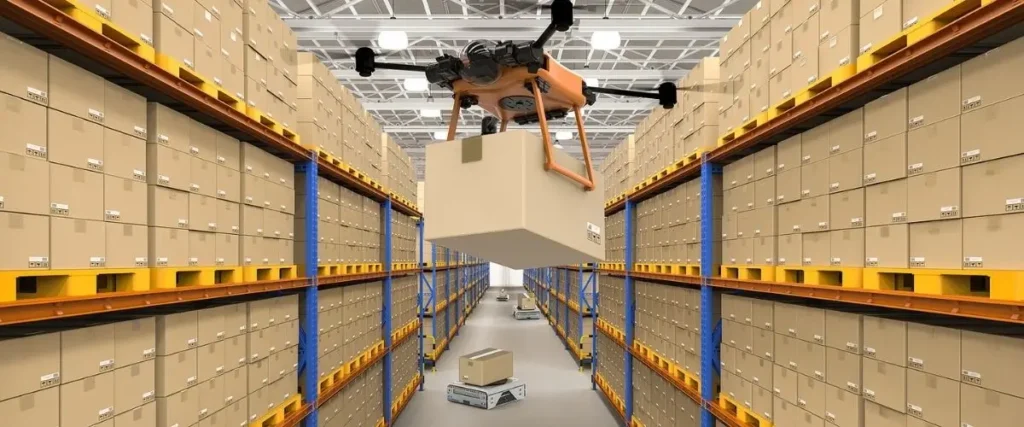
Factory automation with automated guided vehicles and robotic arms in transportation will increase transport with safety. 3D rendering
Logistic robots are highly efficient at order picking and packing, a task that traditionally requires substantial human labor. Advanced robotic systems employ AI and ML algorithms to optimize the order-picking process. These robots can identify the most efficient routes through the warehouse, minimize travel time, and ensure that the correct items are picked and packed accurately. This results in faster order processing, reduced errors, and improved customer satisfaction.
Load Transportation
The movement of heavy loads within a warehouse is strenuous and can pose safety risks for human workers. Logistic robots, however, are designed to handle these tasks with ease. Autonomous mobile robots (AMRs) equipped with load-carrying capabilities can transport pallets, containers, and goods from one location to another, reducing the physical strain on workers and allowing them to focus on more complex tasks. This not only enhances warehouse safety but also improves productivity.
Autonomous Shelf Replenishment
Maintaining organized and accessible shelves is vital for efficient warehouse management. Logistic robots are programmed to autonomously replenish shelves with products as they are depleted. They can identify empty spaces on shelves and refill them with the appropriate items. This real-time replenishment ensures that products are readily available for order fulfillment and minimizes delays caused by manual restocking processes.
The Impact of Logistics Robots on Distribution Centers
Improved Speed and Efficiency
Distribution centers are the heart of supply chain operations, and logistic robots play a pivotal role in ensuring the efficient movement of goods. Robots are capable of working 24/7 without fatigue, resulting in a significant increase in the speed and efficiency of distribution center operations. They can handle tasks such as unloading trucks, sorting products, and preparing orders with unparalleled speed and precision.
Space Optimization
Logistic robots can optimize the use of space within distribution centers. They are designed to navigate in confined spaces and can efficiently stack and retrieve products from shelves. This ability to make the most of available storage space is invaluable in densely packed distribution centers, reducing the need for expansion and leading to cost savings.
Streamlined Cross-Docking
Cross-docking is a logistics strategy where products are transferred directly from inbound to outbound trucks with minimal storage time. Logistic robots can facilitate this process by quickly unloading incoming shipments and routing products to the appropriate outbound trucks. This accelerates the distribution process, reduces storage costs, and minimizes the risk of product damage.
Enhanced Traceability
Traceability is a critical aspect of distribution, especially when dealing with perishable or high-value goods. Logistic robots equipped with tracking technology and sensors can provide end-to-end visibility throughout the distribution process. They can record information about the condition and location of products, ensuring that any issues or discrepancies can be quickly identified and addressed.
The Role of Logistics Robots in Last-Mile Delivery
Autonomous Delivery Vehicles
Logistics robots extend their influence to the last mile of delivery through autonomous delivery vehicles. These vehicles are equipped with advanced AI systems that allow them to navigate urban environments, avoid obstacles, and make autonomous deliveries. The use of autonomous vehicles in the last mile not only reduces delivery costs but also contributes to the reduction of greenhouse gas emissions by optimizing delivery routes and schedules.
Parcel Sorting
Parcel sorting centers play a crucial role in the last-mile delivery process. Logistic robots can efficiently sort parcels based on their size, weight, and destination. The automation of this task ensures that parcels are directed to the correct delivery routes, minimizing errors and delays. Customers receive their orders faster, leading to higher satisfaction levels.
Drone Deliveries
The integration of logistic robots and drones has brought about a new era in last-mile delivery. Drones are capable of delivering packages to remote or hard-to-reach areas quickly. They are particularly useful in emergencies or for delivering medical supplies. The combination of logistics robots and drones expands the reach of last-mile delivery services and improves their responsiveness.
Challenges and Considerations in Implementing Logistics Robots
While logistic robots offer numerous advantages, their implementation is not without challenges and considerations. Companies need to address the following aspects to ensure the successful integration of logistics robots into their operations:
Initial Investment: Acquiring and deploying logistics robots can involve a significant upfront investment. Companies must carefully assess the costs and benefits to justify this investment.
Integration with Existing Systems: Compatibility with existing warehouse management systems (WMS) and enterprise resource planning (ERP) systems is crucial for a seamless integration of logistics robots. Ensuring that these systems can communicate effectively with the robots is essential.
Workforce Training: Training employees to work alongside logistics robots is vital. Workers should be prepared to collaborate with robots and understand their roles in the evolving logistics landscape.
Maintenance and Support: Logistics robots require regular maintenance to ensure their optimal performance. Companies need to have maintenance and support plans in place to minimize downtime and disruptions.
Data Security: The use of AI and ML in logistics robots generates substantial data. Protecting this data from security breaches and ensuring compliance with data protection regulations is a significant concern.
Ethical and Regulatory Considerations: Companies must navigate ethical issues surrounding the use of automation, such as the potential impact on human jobs and safety. Additionally, they should stay informed about evolving regulations related to robotics and automation in the logistics sector.
The Future of Logistics Robots
The future of logistic robots is promising, with continuous advancements in technology and increased adoption across industries. Here are some key trends and developments that will shape the future of logistics robots:
Human-Robot Collaboration: Logistic robots will increasingly collaborate with human workers, working side by side to enhance productivity. Humans will focus on tasks that require creativity, problem-solving, and decision-making, while robots handle repetitive and physically demanding work.
Artificial Intelligence and Machine Learning: Logistic robots will become more intelligent, leveraging AI and ML to improve their ability to navigate complex environments, adapt to changing circumstances, and make real-time decisions.
Enhanced Mobility: Future logistic robots will have improved mobility, enabling them to navigate a wide range of terrains, including outdoor environments. This will expand their applicability in various logistics and delivery scenarios.
Customization and Scalability: Logistic robots will be more customizable and scalable, allowing companies to adapt and expand their robotic fleets to meet specific operational needs.
Sustainability: The integration of logistics robots in delivery and distribution will contribute to sustainability efforts by optimizing delivery routes and reducing emissions. This aligns with the growing emphasis on eco-friendly logistics practices.
Conclusion
Logistics robots are a transformative force in the world of distribution and supply chain management. Their role in warehouse management, distribution centers, and last-mile delivery is reshaping the industry by improving efficiency, reducing costs, and enhancing customer satisfaction. As logistic robots continue to evolve and integrate advanced technologies, they will play a pivotal role in the future of logistics and distribution, contributing to a more efficient, sustainable, and connected global supply chain network.
The optimization of distribution with logistic robots is not just a choice but a necessity for companies looking to stay competitive and meet the ever-increasing demands of the modern consumer. The ability to adapt and embrace these advanced technologies will determine the success of businesses in the logistics industry and beyond. Logistic robots are more than just machines; they are the architects of a smarter, more efficient, and agile supply chain ecosystem.